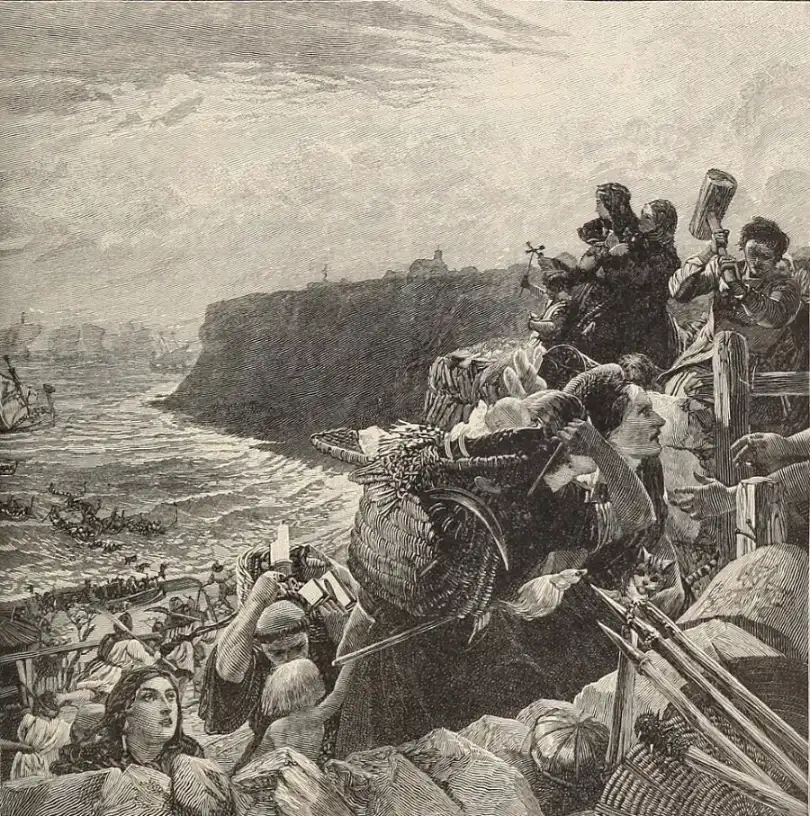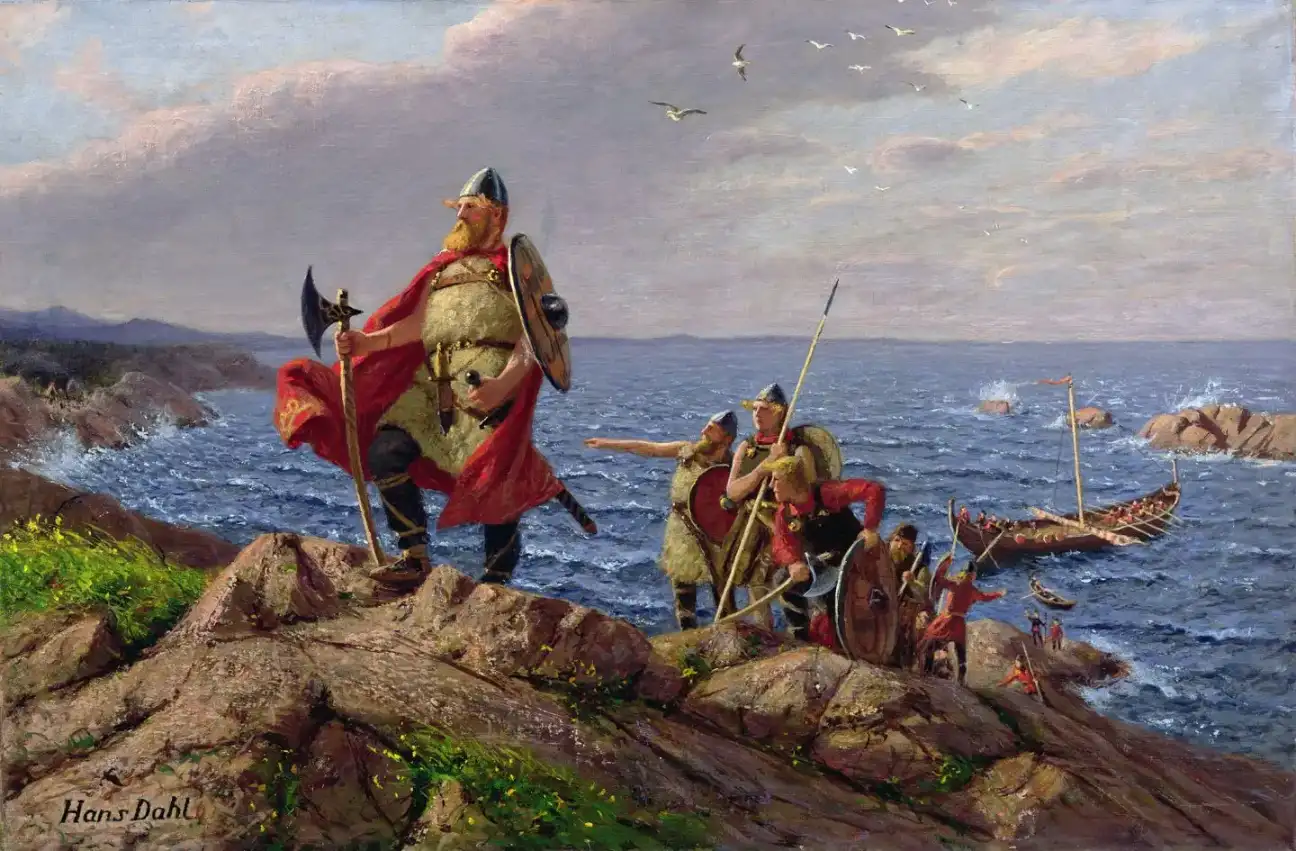
Viking ship on a foaming sea, painted by Hans Dahl
The Gisli Clan's coat of arms: the raven in the laurel wreath with the words Gisli of Denmark

Gísli.

An Icelandic family chronicle from Rome via Lejre, Norway, Iceland and Greenland to Køge

Behind the name Gisli stand a thousand years of Iceland: priests and lawmen, knights and Jerusalem pilgrims, the saga writer Snorri Sturluson and the kings of Norway. Along the way the family has lived in Rome, Ravenna and Constantinople, in Carthage, in Kyiv, at Lejre and Uppsala, in Northumbria, Norway, Iceland and Greenland, before it put down roots in Køge.

2proposed lines of descent from Olaf Gisli to Ragnar Lodbrok, each of about 36 generations
~58generations to Odin and Skjold
3Norwegian kings and four Roman emperors
XIVGislis in Denmark
Hans Dahl · public domain
Preface

A family told as a saga

Icelanders have always known their lineage. As early as the 12th century they wrote Landnámabók, a book of the first settlers and their descendants, and to this day almost every Icelander can trace their ancestry many hundreds of years back.

Gisli of Denmark began with an Icelandic ship's mate, Gísli Ólafsson, who came to Copenhagen during the First World War, and his Danish son Olaf, born in 1917. Olaf became the first Gisli of Denmark. Behind them the family runs through priests, lawmen and bishops to Björn Jórsalafari, who sailed to Greenland, Rome and Jerusalem around the year 1400. From there it divides into two paths to Ragnar Lodbrok: through knights at Vatnsfjörður, Snorri Sturluson and Landnámabók's generations to Ragnar's son Björn Ironside, and through the Oddi family and the kings of Norway to his son Sigurd Snake-in-the-Eye. Before Ragnar the family tree continues to the legendary kings of Lejre and the god Odin and, according to the English genealogy books, through a Vandal princess to the emperors of Rome.

The further back we go, the more the family tree rests on sagas and medieval genealogical registers. We tell the stories as the sources tell them, and for each person we mark how reliable the source is.

The lines of descent

Two paths to Ragnar Lodbrok

Choose a line and follow it generation by generation from Olaf Gisli. The number is the number of generations back. Click a name to read about the person and see the sources. Names with a gold dot have their own entry in the book. Below Ragnar you can unfold the line to Sigurd Ring, Odin and the emperors of Rome. Under Side branches you will find the families that have come in through a spouse.

The direct line through the Stephensen family, Bishop Jón Vigfússon, Solveig, wife of the Jerusalem pilgrim Björn Jórsalafari, the Oddi family and the kings of Norway to Ragnar Lodbrok's son Sigurd Snake-in-the-Eye.

  1. 0Master builder and resistance fighter
  2. 1Ship's mate, Olaf's father
  3. 2⚭ Guðrún Birgitta Gísladóttir
  4. 3⚭ Ólafur Pálsson
  5. 4inherited Viðey
  6. 5Chief justice, man of the Enlightenment and printer
  7. 6Iceland's first Icelandic-born governor
  8. 7from Espihóll
  9. 8the bishop's daughter
  10. 9Bishop of Hólar
  11. 10schoolmaster and district sheriff
  12. 11⚭ Gísli Hákonarson
  13. 12dean at Garðar
  14. 13mother of Bishop Guðbrandur
  15. 14Lawman of North and West Iceland
  16. 15⚭ Sigmundur Steinþórsson
  17. 16⚭ Þorleifur Árnason
  18. 17⚭ Björn Jórsalafari
  19. 18The Stórólfshvoll branch
  20. 19· · ·family connection through the Stórólfshvoll branch
  21. 20⚭ Þorsteinn Halldórsson
  22. 21chieftain (goði)
  23. 22Oddi
  24. 23Chieftain at Oddi, grandson of a king
  25. 24⚭ Loftur Sæmundsson
  26. 25King of Norway
  27. 26founded Bergen
  28. 27Varangian commander and king of Norway
  29. 28king of Ringerike
  30. 29
  31. 30son of Harald and Snefrid
  32. 31First king of all Norway
  33. 32Harald's mother
  34. 33king of Ringerike
  35. 34
  36. 35Son of Ragnar, Danish king
  37. 36Viking king and saga hero
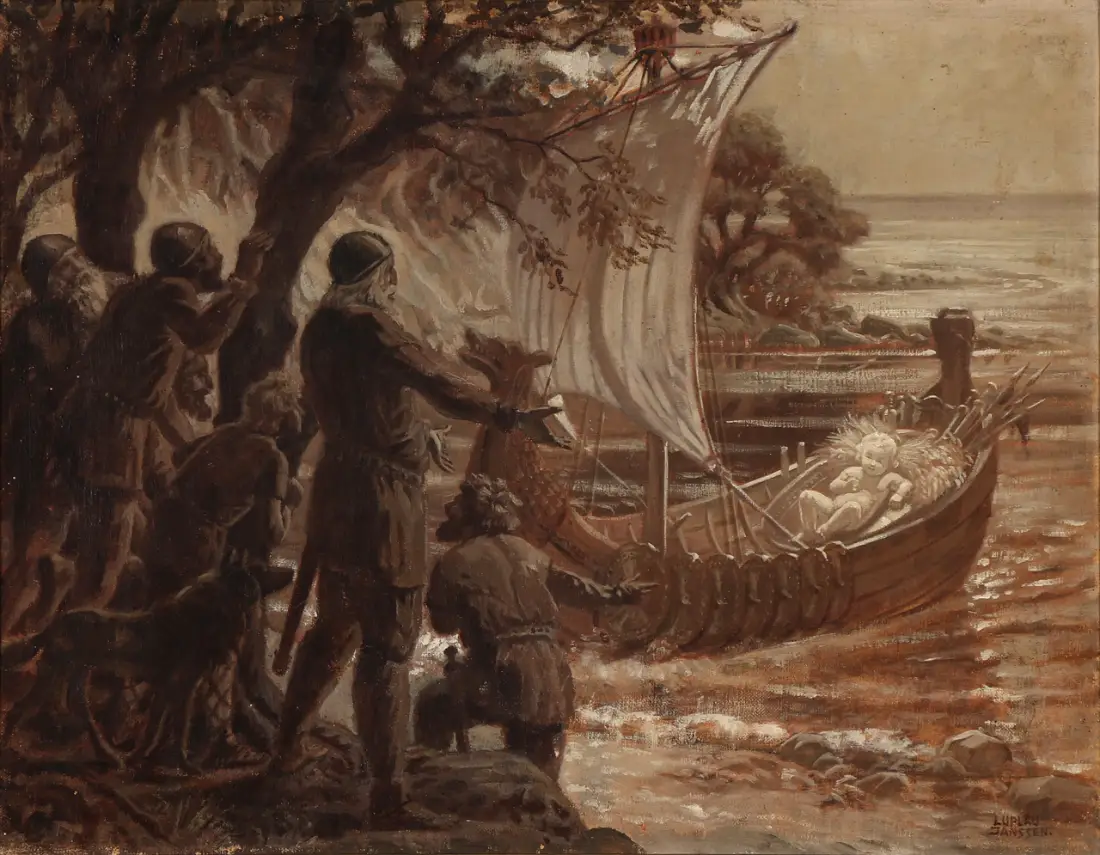
Luplau Janssen, King Skjold Comes to Denmark (1912)
Myth · Lejre · 500–800

Gods and legendary kings

Scyld, son of the sheaf, seized the mead-benches of many tribes. A foundling he was, found by the shore; he grew to power.Beowulf, lines 4–7 (freely translated)
Luplau Janssen, King Skjold Comes to Denmark (1912)

The family's oldest generations are found in the sagas and chronicles, not in the parish registers. Here are the gods and kings to whom the medieval scribes of the North traced their rulers, from Odin through the kings of Lejre to the battle on the plain of Brávellir.

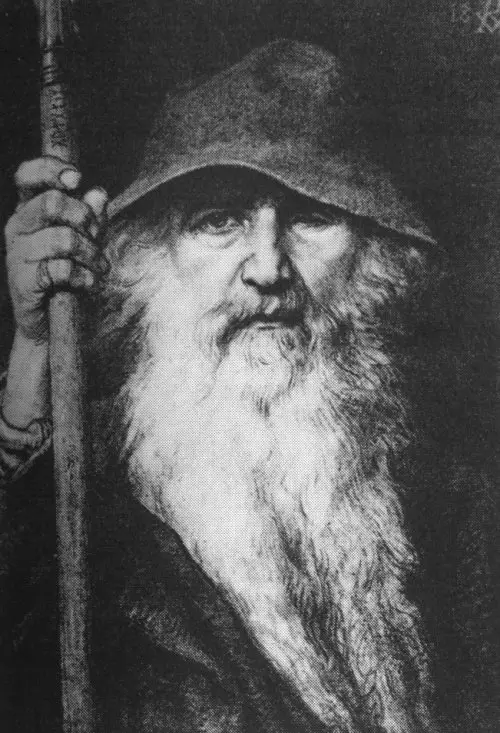
Georg von Rosen, Odin as a Wanderer (1886)
Georg von Rosen, Odin as a Wanderer (1886)Public domain
MythMyth

Odin

All-Father · Father of the Slain
Chieftain of the Æsir

The one-eyed wanderer who gave his eye for wisdom and hung nine nights on the world tree to win the runes. Medieval scribes made him the forefather of the royal houses of the North. That is why he is the very first link in our family tree, furthest back in time.

Read the whole story

In the Eddic poems Odin is the highest of the Æsir. He sacrificed one of his eyes in Mímir's well to gain a share of its wisdom. In the poem Hávamál he tells himself how he hung for nine nights on the windswept tree, wounded by his own spear, until he seized the runes and fell down again.

He rides the eight-legged horse Sleipnir. His two ravens, Huginn and Muninn, thought and memory, fly out over the world every morning and return home with news. In Valhalla he gathers the fallen warriors who are to fight at his side at Ragnarök. According to a widely held interpretation, the Ledberg Stone in Östergötland shows Odin himself being swallowed by the wolf Fenrir at the end of the world.

When Christian scribes wrote down the royal genealogies in the 12th and 13th centuries, they made Odin a human chieftain who had wandered north from Asia. Snorri Sturluson opens both his Edda and Heimskringla in this way. Thus Danish, Norwegian and Swedish kings gained a divine forefather, and thus the oldest line of the Gísli family also ends with Odin.
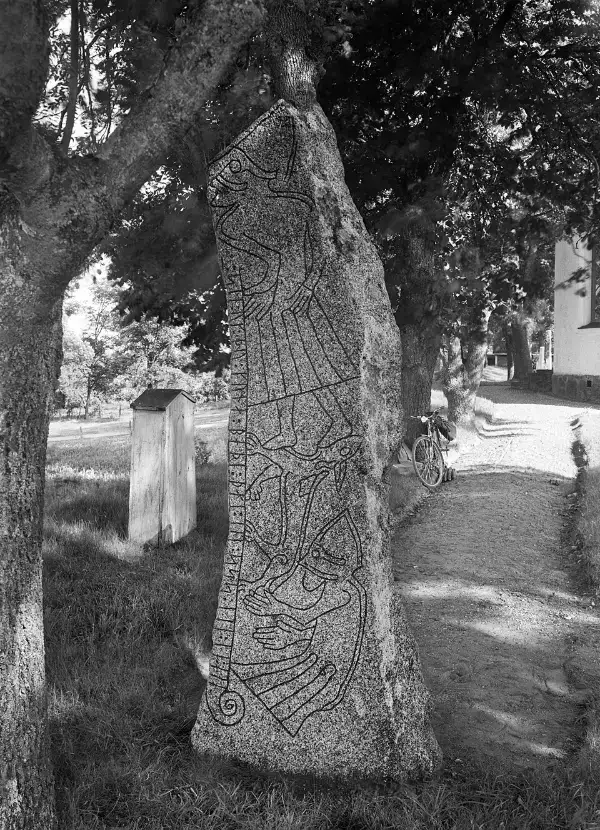
The Ledberg Stone, Östergötland. The image is interpreted as Odin being swallowed by the wolf Fenrir
Sources
The Poetic Edda, Snorri's Edda, Ynglinga saga
Son in the family tree
Skjold, king at Lejre
See the line from Olaf Gisli to Odin

58 generations.
  1. 0
  2. 1
  3. 2⚭ Guðrún Birgitta Gísladóttir
  4. 3⚭ Ólafur Pálsson
  5. 4inherited Viðey
  6. 5
  7. 6
  8. 7from Espihóll
  9. 8the bishop's daughter
  10. 9
  11. 10schoolmaster and district sheriff
  12. 11⚭ Gísli Hákonarson
  13. 12dean at Garðar
  14. 13mother of Bishop Guðbrandur
  15. 14
  16. 15⚭ Sigmundur Steinþórsson
  17. 16⚭ Þorleifur Árnason
  18. 17⚭ Björn Jórsalafari
  19. 18The Stórólfshvoll branch
  20. 19· · ·family connection through the Stórólfshvoll branch
  21. 20⚭ Þorsteinn Halldórsson
  22. 21chieftain (goði)
  23. 22Oddi
  24. 23
  25. 24⚭ Loftur Sæmundsson
  26. 25
  27. 26founded Bergen
  28. 27
  29. 28king of Ringerike
  30. 29
  31. 30son of Harald and Snefrid
  32. 31
  33. 32Harald's mother
  34. 33king of Ringerike
  35. 34
  36. 35
  37. 36
  38. 37
  39. 38
  40. 39
  41. 40
  42. 41
  43. 42⚭ Hild
  44. 43⚭ Hildis
  45. 44
  46. 45
  47. 46
  48. 47
  49. 48
  50. 49
  51. 50
  52. 51
  53. 52
  54. 53
  55. 54
  56. 55
  57. 56
  58. 57
  59. 58
Luplau Janssen, King Skjold Comes to Denmark (1912)
Luplau Janssen, King Skjold Comes to Denmark (1912)Public domain
SagaLegendary age

Skjold

Skjöldr · Scyld Scefing
Forefather of the Skjoldungs, king at Lejre

He came to Denmark as a small child in a ship without a crew. The Danes made him their king, and from him descend the Skjoldungs, the kings of Lejre.

Read the whole story

The legend tells of lawless and poor times among the Danes, until one day a ship drifted in towards the coast. There was no one at the oars and no one at the helm. On deck lay a little boy with a sheaf of corn beneath his head and weapons stacked around him. The people carried him to the assembly place, set him on the sacred stone and proclaimed him king.

The Old English poem Beowulf begins with him, under the name Scyld Scefing, “Scyld of the Sheaf”. He became a ruler to whom the peoples along “the whale's road” paid tribute. When he died, his people laid him in a ship filled with treasures and let the sea take him back.

According to the Skjöldunga saga he was the son of Odin, and he ruled from the royal estate at Lejre. Archaeologists have found great royal halls at Gammel Lejre from the Iron Age and the Viking Age. In our family tree the line runs from Skjold through Fridleif, Frode the Peaceful and a long succession of Lejre kings to Hroar.

Sources
Beowulf, Skjöldunga saga, Saxo, the Lejre Chronicle
Royal seat
Lejre on Zealand
See the line from Olaf Gisli to Skjold

57 generations.

  1. 0
  2. 1
  3. 2⚭ Guðrún Birgitta Gísladóttir
  4. 3⚭ Ólafur Pálsson
  5. 4inherited Viðey
  6. 5
  7. 6
  8. 7from Espihóll
  9. 8the bishop's daughter
  10. 9
  11. 10schoolmaster and district sheriff
  12. 11⚭ Gísli Hákonarson
  13. 12dean at Garðar
  14. 13mother of Bishop Guðbrandur
  15. 14
  16. 15⚭ Sigmundur Steinþórsson
  17. 16⚭ Þorleifur Árnason
  18. 17⚭ Björn Jórsalafari
  19. 18The Stórólfshvoll branch
  20. 19· · ·family connection through the Stórólfshvoll branch
  21. 20⚭ Þorsteinn Halldórsson
  22. 21chieftain (goði)
  23. 22Oddi
  24. 23
  25. 24⚭ Loftur Sæmundsson
  26. 25
  27. 26founded Bergen
  28. 27
  29. 28king of Ringerike
  30. 29
  31. 30son of Harald and Snefrid
  32. 31
  33. 32Harald's mother
  34. 33king of Ringerike
  35. 34
  36. 35
  37. 36
  38. 37
  39. 38
  40. 39
  41. 40
  42. 41
  43. 42⚭ Hild
  44. 43⚭ Hildis
  45. 44
  46. 45
  47. 46
  48. 47
  49. 48
  50. 49
  51. 50
  52. 51
  53. 52
  54. 53
  55. 54
  56. 55
  57. 56
  58. 57
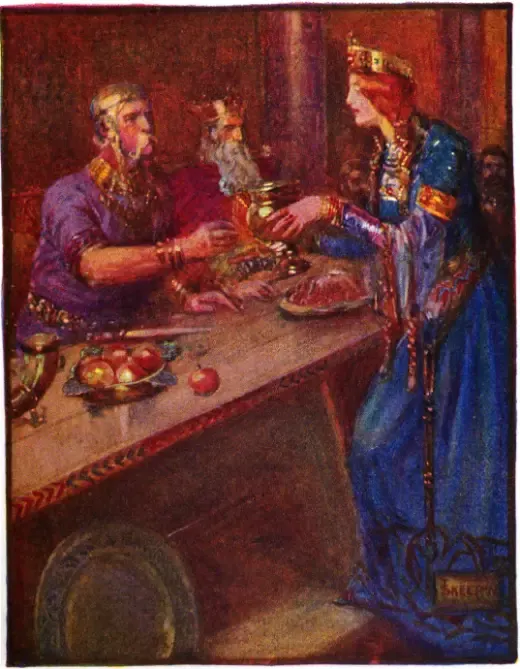
J. R. Skelton, Queen Wealhtheow Pours Mead in King Hroðgar's Hall Heorot (1908). Hroðgar is the Beowulf poem's name for Hroar
J. R. Skelton, Queen Wealhtheow Pours Mead in King Hroðgar's Hall Heorot (1908). Hroðgar is the Beowulf poem's name for HroarPublic domain
SagaLegendary age

Hroar

Hróarr · Hrothgar · Roe
Legendary king at Lejre and Roskilde

In Beowulf he is called Hrothgar and builds the golden mead hall Heorot, which the monster Grendel haunts. Danish tradition says that he gave his name to Roskilde.

Read the whole story

Hroar is one of the few Danish legendary kings who appear in both Norse and Anglo-Saxon sources. In Beowulf he is the old, generous king who has the magnificent hall Heorot built. Every night the monster Grendel comes and kills his men, until the young hero Beowulf crosses the sea and slays it.

In Saxo and the Roskilde Chronicle he is called King Roe, who according to tradition founded Roskilde, “Roar's spring”. Many scholars believe that Heorot corresponds to the royal estate at Lejre, half an hour's drive from Køge.

According to the genealogical registers, his son Valdar married Hildis, daughter of the Vandal king Hilderic. Here the two oldest branches of the family tree meet, Lejre and Rome. Through their son Harald the line continues to Halfdan the Valiant, Ivar Vidfamne and finally Ragnar Lodbrok.

Sources
Beowulf, Saxo, the Roskilde Chronicle
See the line from Olaf Gisli to Hroar

44 generations.

  1. 0
  2. 1
  3. 2⚭ Guðrún Birgitta Gísladóttir
  4. 3⚭ Ólafur Pálsson
  5. 4inherited Viðey
  6. 5
  7. 6
  8. 7from Espihóll
  9. 8the bishop's daughter
  10. 9
  11. 10schoolmaster and district sheriff
  12. 11⚭ Gísli Hákonarson
  13. 12dean at Garðar
  14. 13mother of Bishop Guðbrandur
  15. 14
  16. 15⚭ Sigmundur Steinþórsson
  17. 16⚭ Þorleifur Árnason
  18. 17⚭ Björn Jórsalafari
  19. 18The Stórólfshvoll branch
  20. 19· · ·family connection through the Stórólfshvoll branch
  21. 20⚭ Þorsteinn Halldórsson
  22. 21chieftain (goði)
  23. 22Oddi
  24. 23
  25. 24⚭ Loftur Sæmundsson
  26. 25
  27. 26founded Bergen
  28. 27
  29. 28king of Ringerike
  30. 29
  31. 30son of Harald and Snefrid
  32. 31
  33. 32Harald's mother
  34. 33king of Ringerike
  35. 34
  36. 35
  37. 36
  38. 37
  39. 38
  40. 39
  41. 40
  42. 41
  43. 42⚭ Hild
  44. 43⚭ Hildis
  45. 44
Bror Hillgren, Ivar Vidfamne (1915)
Bror Hillgren, Ivar Vidfamne (1915)Public domain
Sagac. 650–700

Ivar Vidfamne

Ívarr inn víðfaðmi
Legendary king over Denmark and Sweden

The byname means “the far-reaching”. The sagas have him unite Denmark, Sweden and large parts of the Baltic lands under one crown.

Read the whole story

According to the sagas, Ivar came from Scania. Through cunning, marriage and war he expanded his realm until it included Denmark, Sweden, parts of Norway and Saxony and, according to some sources, part of England as well. He is mentioned only in Icelandic and Norwegian sources, so historians regard him as a semi-legendary figure.

He died around the year 700 in Karelia. His daughter Aud, who stands in our family tree, became the mother of Harald Wartooth and Randver, and through her the inheritance passes on to Sigurd Ring and Ragnar Lodbrok.

Sources
Hervarar saga, Ynglinga saga, Sögubrot
Daughter in the family tree
Queen Aud
See the line from Olaf Gisli to Ivar Vidfamne

40 generations.

  1. 0
  2. 1
  3. 2⚭ Guðrún Birgitta Gísladóttir
  4. 3⚭ Ólafur Pálsson
  5. 4inherited Viðey
  6. 5
  7. 6
  8. 7from Espihóll
  9. 8the bishop's daughter
  10. 9
  11. 10schoolmaster and district sheriff
  12. 11⚭ Gísli Hákonarson
  13. 12dean at Garðar
  14. 13mother of Bishop Guðbrandur
  15. 14
  16. 15⚭ Sigmundur Steinþórsson
  17. 16⚭ Þorleifur Árnason
  18. 17⚭ Björn Jórsalafari
  19. 18The Stórólfshvoll branch
  20. 19· · ·family connection through the Stórólfshvoll branch
  21. 20⚭ Þorsteinn Halldórsson
  22. 21chieftain (goði)
  23. 22Oddi
  24. 23
  25. 24⚭ Loftur Sæmundsson
  26. 25
  27. 26founded Bergen
  28. 27
  29. 28king of Ringerike
  30. 29
  31. 30son of Harald and Snefrid
  32. 31
  33. 32Harald's mother
  34. 33king of Ringerike
  35. 34
  36. 35
  37. 36
  38. 37
  39. 38
  40. 39
  41. 40
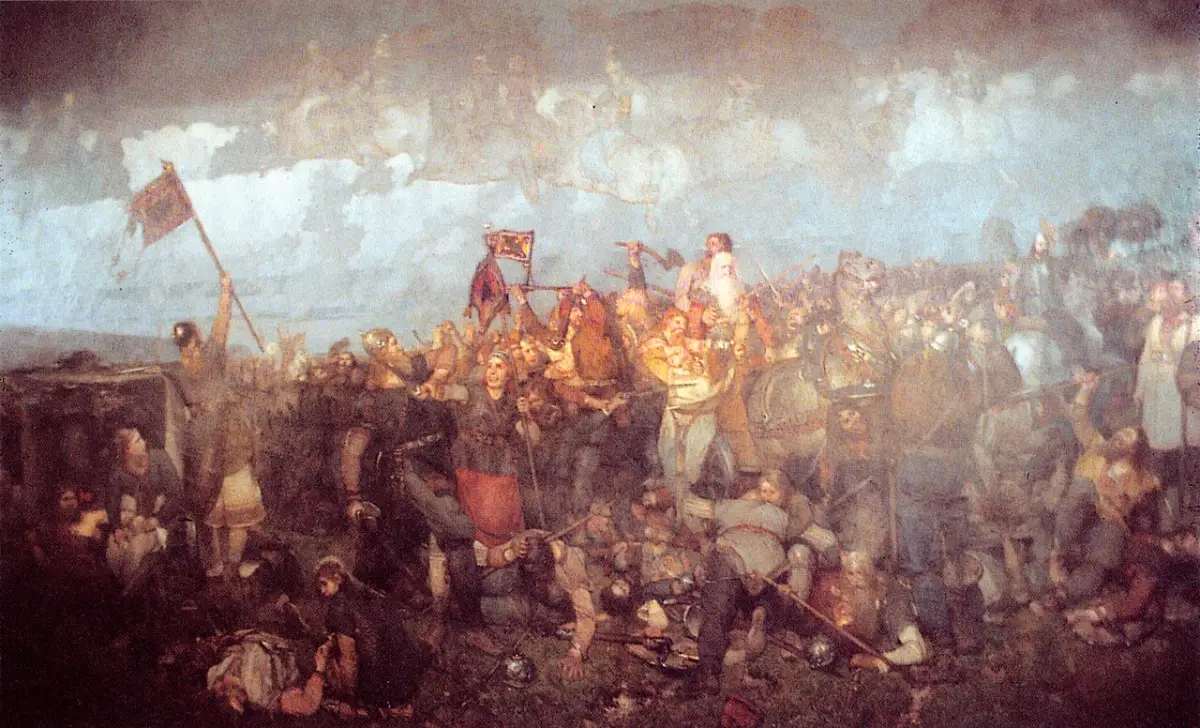
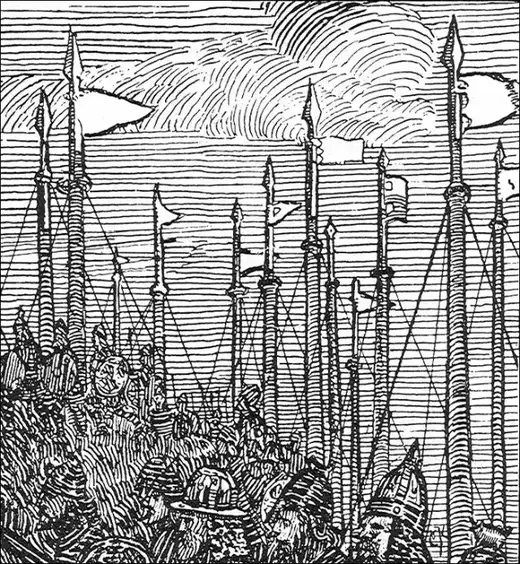
August Malmström, The Battle of Brávellir
August Malmström, The Battle of BrávellirPublic domain
Saga8th century

Sigurd Ring

Sigurðr hringr · and the Battle of Brávellir
King, father of Ragnar Lodbrok

The greatest legendary battle of the North. The old King Harald Wartooth met his nephew Sigurd Ring on the plain of Brávellir, and according to legend Odin himself came down and slew Harald.

Read the whole story

Harald Wartooth was the son of Aud and grandson of Ivar Vidfamne. He gathered the whole of his maternal grandfather's realm and reigned so long that in the end he was old and blind. His nephew Sigurd Ring governed Sweden under him, but turned against him.

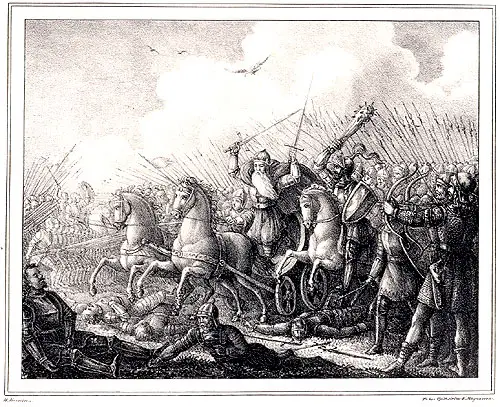
Saxo describes the battle as a clash between all the champions of the North, with shieldmaidens and named heroes on both sides. Harald was driven into battle in a chariot. His counsellor Bruni was in truth Odin in disguise, and it was Odin who finally killed him with his own club.

Sigurd Ring won and became king over Denmark and Sweden. His son was Ragnar Lodbrok. In the Gísli family tree, Sigurd Ring is thus the link between the legendary kings of Lejre and the most famous name of the Viking Age.

Hugo Hamilton, King Harald Wartooth Falls in the Battle of Brávellir
Sources
Saxo, Sögubrot, Hervarar saga
Son
Ragnar Lodbrok
See the line from Olaf Gisli to Sigurd Ring

37 generations.

  1. 0
  2. 1
  3. 2⚭ Guðrún Birgitta Gísladóttir
  4. 3⚭ Ólafur Pálsson
  5. 4inherited Viðey
  6. 5
  7. 6
  8. 7from Espihóll
  9. 8the bishop's daughter
  10. 9
  11. 10schoolmaster and district sheriff
  12. 11⚭ Gísli Hákonarson
  13. 12dean at Garðar
  14. 13mother of Bishop Guðbrandur
  15. 14
  16. 15⚭ Sigmundur Steinþórsson
  17. 16⚭ Þorleifur Árnason
  18. 17⚭ Björn Jórsalafari
  19. 18The Stórólfshvoll branch
  20. 19· · ·family connection through the Stórólfshvoll branch
  21. 20⚭ Þorsteinn Halldórsson
  22. 21chieftain (goði)
  23. 22Oddi
  24. 23
  25. 24⚭ Loftur Sæmundsson
  26. 25
  27. 26founded Bergen
  28. 27
  29. 28king of Ringerike
  30. 29
  31. 30son of Harald and Snefrid
  32. 31
  33. 32Harald's mother
  34. 33king of Ringerike
  35. 34
  36. 35
  37. 36
  38. 37
The starry sky in the Mausoleum of Galla Placidia, Ravenna
The Roman Empire · 379–530

The emperors of Rome

We know their faces from the gold.
The starry sky in the Mausoleum of Galla Placidia, Ravenna

According to the English genealogy books, King Valdar at Lejre married the Vandal princess Hildis. Through her a branch of the family tree runs to the Theodosian dynasty, the last great imperial house of late antiquity. Their portraits survive on gold coins, solidi, which are laid out here in the coin cabinet.

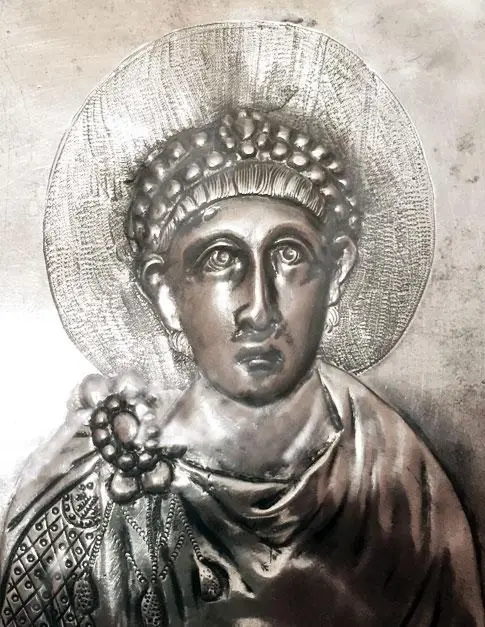
Theodosius I on the silver dish from Mérida, the Missorium of Theodosius (388)
Theodosius I on the silver dish from Mérida, the Missorium of Theodosius (388)Public domain
Historical347–395 · emperor 379–395D N THEODOSIVS P F AVG

Theodosius I

the Great
Roman emperor

The last emperor to rule over the whole Roman Empire. On the silver dish from Mérida he sits enthroned with a halo, between his co-emperors.

Read the whole story

Theodosius was the son of the general Count Theodosius, who had put down rebellions in Britain and Africa. His father was executed in Carthage in 376. Three years later Emperor Gratian appointed the son co-emperor in the East after the Romans' catastrophic defeat at Adrianople.

In 380, with the Edict of Thessalonica, he made Nicene Christianity the religion of the empire. He won two civil wars against usurpers in the West and in 394 briefly united the whole empire under his rule, before he died in Milan in January 395. The empire was divided between his sons Arcadius and Honorius and was never reunited.

The silver dish, the Missorium of Theodosius, was made for his tenth anniversary in 388 and was found in Spain in 1847. He is the forefather of both Valentinian III and his wife Licinia Eudoxia.

Father
Count Theodosius († 376)
Children in the family tree
Arcadius and Galla Placidia
See the line from Olaf Gisli to Theodosius I

48 generations.

  1. 0
  2. 1
  3. 2⚭ Guðrún Birgitta Gísladóttir
  4. 3⚭ Ólafur Pálsson
  5. 4inherited Viðey
  6. 5
  7. 6
  8. 7from Espihóll
  9. 8the bishop's daughter
  10. 9
  11. 10schoolmaster and district sheriff
  12. 11⚭ Gísli Hákonarson
  13. 12dean at Garðar
  14. 13mother of Bishop Guðbrandur
  15. 14
  16. 15⚭ Sigmundur Steinþórsson
  17. 16⚭ Þorleifur Árnason
  18. 17⚭ Björn Jórsalafari
  19. 18The Stórólfshvoll branch
  20. 19· · ·family connection through the Stórólfshvoll branch
  21. 20⚭ Þorsteinn Halldórsson
  22. 21chieftain (goði)
  23. 22Oddi
  24. 23
  25. 24⚭ Loftur Sæmundsson
  26. 25
  27. 26founded Bergen
  28. 27
  29. 28king of Ringerike
  30. 29
  31. 30son of Harald and Snefrid
  32. 31
  33. 32Harald's mother
  34. 33king of Ringerike
  35. 34
  36. 35
  37. 36
  38. 37
  39. 38
  40. 39
  41. 40
  42. 41
  43. 42⚭ Hild
  44. 43Vandal princess
  45. 44
  46. 45
  47. 46
  48. 47
  49. 48
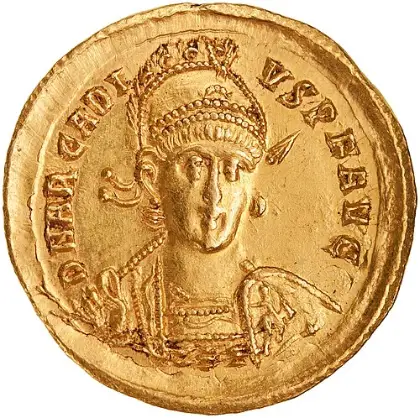
Guldmønt med portræt af Arcadius
Gold solidus, Arcadius, 403CC0
Historical377–408 · emperor 395–408D N ARCADIVS P F AVG

Arcadius

Eastern Roman emperor

Eldest son of Theodosius the Great. He was only 17 when he took over the eastern half of the empire, with its capital at Constantinople.

Read the whole story

Arcadius is not considered a strong ruler. Real power lay with his advisers and with his energetic wife Aelia Eudoxia. The coin shown here was struck in 403 and depicts him with a pearl diadem and imperial armour.

He was the half-brother of Galla Placidia, and his son Theodosius II became the father of Licinia Eudoxia. Through him runs the Eastern Roman branch of the family.

Capital
Constantinople
Son
Theodosius II
See the line from Olaf Gisli to Arcadius

48 generations.

  1. 0
  2. 1
  3. 2⚭ Guðrún Birgitta Gísladóttir
  4. 3⚭ Ólafur Pálsson
  5. 4inherited Viðey
  6. 5
  7. 6
  8. 7from Espihóll
  9. 8the bishop's daughter
  10. 9
  11. 10schoolmaster and district sheriff
  12. 11⚭ Gísli Hákonarson
  13. 12dean at Garðar
  14. 13mother of Bishop Guðbrandur
  15. 14
  16. 15⚭ Sigmundur Steinþórsson
  17. 16⚭ Þorleifur Árnason
  18. 17⚭ Björn Jórsalafari
  19. 18The Stórólfshvoll branch
  20. 19· · ·family connection through the Stórólfshvoll branch
  21. 20⚭ Þorsteinn Halldórsson
  22. 21chieftain (goði)
  23. 22Oddi
  24. 23
  25. 24⚭ Loftur Sæmundsson
  26. 25
  27. 26founded Bergen
  28. 27
  29. 28king of Ringerike
  30. 29
  31. 30son of Harald and Snefrid
  32. 31
  33. 32Harald's mother
  34. 33king of Ringerike
  35. 34
  36. 35
  37. 36
  38. 37
  39. 38
  40. 39
  41. 40
  42. 41
  43. 42⚭ Hild
  44. 43Vandal princess
  45. 44
  46. 45
  47. 46
  48. 47
  49. 48
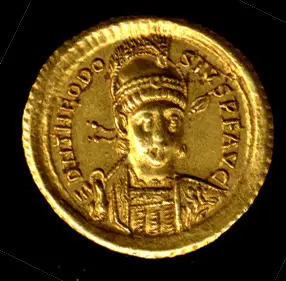
Guldmønt med portræt af Theodosius II
Gold solidus, Theodosius II (408–450)CC0
Historical401–450 · emperor 408–450D N THEODOSIVS P F AVG

Theodosius II

Eastern Roman emperor

Became emperor at the age of seven and reigned for 42 years. Under him Constantinople gained the walls that held the city for a thousand years.

Read the whole story

The Theodosian land walls were built from 413 and made Constantinople almost impregnable until 1453. He also had Roman law collected in the law code Codex Theodosianus, which came into force in 438.

His wife was the poet Aelia Eudocia, and their daughter Licinia Eudoxia married Valentinian III in Constantinople in 437. For the wedding a gold coin was struck on which Theodosius stands between the bride and groom. He died in 450 after a fall from his horse.

Law code
Codex Theodosianus, 438
Daughter
Licinia Eudoxia
See the line from Olaf Gisli to Theodosius II

47 generations.

  1. 0
  2. 1
  3. 2⚭ Guðrún Birgitta Gísladóttir
  4. 3⚭ Ólafur Pálsson
  5. 4inherited Viðey
  6. 5
  7. 6
  8. 7from Espihóll
  9. 8the bishop's daughter
  10. 9
  11. 10schoolmaster and district sheriff
  12. 11⚭ Gísli Hákonarson
  13. 12dean at Garðar
  14. 13mother of Bishop Guðbrandur
  15. 14
  16. 15⚭ Sigmundur Steinþórsson
  17. 16⚭ Þorleifur Árnason
  18. 17⚭ Björn Jórsalafari
  19. 18The Stórólfshvoll branch
  20. 19· · ·family connection through the Stórólfshvoll branch
  21. 20⚭ Þorsteinn Halldórsson
  22. 21chieftain (goði)
  23. 22Oddi
  24. 23
  25. 24⚭ Loftur Sæmundsson
  26. 25
  27. 26founded Bergen
  28. 27
  29. 28king of Ringerike
  30. 29
  31. 30son of Harald and Snefrid
  32. 31
  33. 32Harald's mother
  34. 33king of Ringerike
  35. 34
  36. 35
  37. 36
  38. 37
  39. 38
  40. 39
  41. 40
  42. 41
  43. 42⚭ Hild
  44. 43Vandal princess
  45. 44
  46. 45
  47. 46
  48. 47
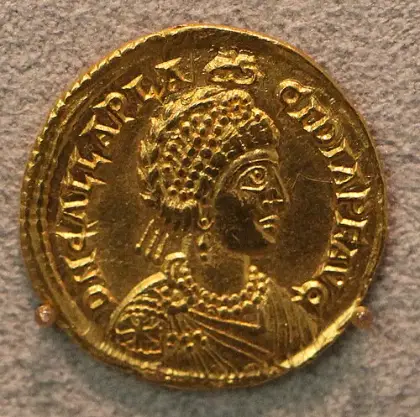
Guldmønt med portræt af Galla Placidia
Gold solidus, Galla Placidia, 422CC BY 3.0
Historicalc. 392–450D N GALLA PLACIDIA P F AVG

Galla Placidia

Empress and regent of the Western Empire

Emperor's daughter, prisoner of war, Gothic queen and finally regent of the Western Roman Empire. Her life is one of the most dramatic of late antiquity.

Read the whole story

She was the daughter of Theodosius the Great. When the Visigoths sacked Rome in 410, she was carried off as a hostage. Four years later she married the Gothic king Ataulf and became queen of the Visigoths.

After Ataulf's death she was sent back and married to the general Constantius, who in 421 briefly became Emperor Constantius III. Their son was Valentinian III. From 425 she governed the Western Empire as regent for her young son.

Her name is linked to the small mausoleum in Ravenna whose ceiling is covered with star mosaics on a deep blue ground. It is one of the best-preserved monuments from her time.

The starry sky in the Mausoleum of Galla Placidia, Ravenna
Husbands
Ataulf, king of the Visigoths · Constantius III
Son
Valentinian III
See the line from Olaf Gisli to Galla Placidia

47 generations.

  1. 0
  2. 1
  3. 2⚭ Guðrún Birgitta Gísladóttir
  4. 3⚭ Ólafur Pálsson
  5. 4inherited Viðey
  6. 5
  7. 6
  8. 7from Espihóll
  9. 8the bishop's daughter
  10. 9
  11. 10schoolmaster and district sheriff
  12. 11⚭ Gísli Hákonarson
  13. 12dean at Garðar
  14. 13mother of Bishop Guðbrandur
  15. 14
  16. 15⚭ Sigmundur Steinþórsson
  17. 16⚭ Þorleifur Árnason
  18. 17⚭ Björn Jórsalafari
  19. 18The Stórólfshvoll branch
  20. 19· · ·family connection through the Stórólfshvoll branch
  21. 20⚭ Þorsteinn Halldórsson
  22. 21chieftain (goði)
  23. 22Oddi
  24. 23
  25. 24⚭ Loftur Sæmundsson
  26. 25
  27. 26founded Bergen
  28. 27
  29. 28king of Ringerike
  30. 29
  31. 30son of Harald and Snefrid
  32. 31
  33. 32Harald's mother
  34. 33king of Ringerike
  35. 34
  36. 35
  37. 36
  38. 37
  39. 38
  40. 39
  41. 40
  42. 41
  43. 42⚭ Hild
  44. 43Vandal princess
  45. 44
  46. 45
  47. 46
  48. 47
Guldmønt med portræt af Valentinian III
Gold solidus, Valentinian III, 426–430CC0
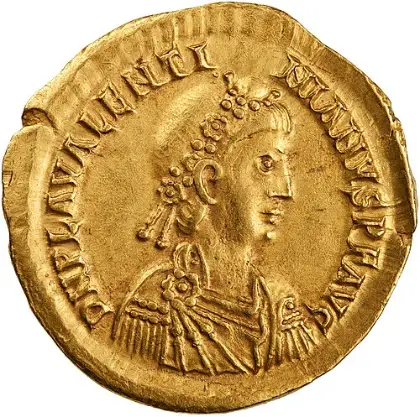
Historical419–455 · emperor 425–455D N PLA VALENTINIANVS P F AVG

Valentinian III

Western Roman emperor

Became emperor at the age of six and reigned for thirty years while the Western Empire crumbled. He was murdered on the Campus Martius in Rome in March 455.

Read the whole story

He was the son of Galla Placidia and Constantius III. During his reign the Western Empire lost wealthy North Africa to the Vandals, and the Hunnic king Attila invaded Gaul and Italy. It was the general Aëtius who held the empire together.

In 454 Valentinian himself killed Aëtius during a meeting in the palace. Half a year later, on 16 March 455, the emperor was killed by two of Aëtius' former bodyguards. The murder set off the chain of events that brought the Vandals to Rome that same summer.

Mother
Galla Placidia
Wife
Licinia Eudoxia
See the line from Olaf Gisli to Valentinian III

46 generations.

  1. 0
  2. 1
  3. 2⚭ Guðrún Birgitta Gísladóttir
  4. 3⚭ Ólafur Pálsson
  5. 4inherited Viðey
  6. 5
  7. 6
  8. 7from Espihóll
  9. 8the bishop's daughter
  10. 9
  11. 10schoolmaster and district sheriff
  12. 11⚭ Gísli Hákonarson
  13. 12dean at Garðar
  14. 13mother of Bishop Guðbrandur
  15. 14
  16. 15⚭ Sigmundur Steinþórsson
  17. 16⚭ Þorleifur Árnason
  18. 17⚭ Björn Jórsalafari
  19. 18The Stórólfshvoll branch
  20. 19· · ·family connection through the Stórólfshvoll branch
  21. 20⚭ Þorsteinn Halldórsson
  22. 21chieftain (goði)
  23. 22Oddi
  24. 23
  25. 24⚭ Loftur Sæmundsson
  26. 25
  27. 26founded Bergen
  28. 27
  29. 28king of Ringerike
  30. 29
  31. 30son of Harald and Snefrid
  32. 31
  33. 32Harald's mother
  34. 33king of Ringerike
  35. 34
  36. 35
  37. 36
  38. 37
  39. 38
  40. 39
  41. 40
  42. 41
  43. 42⚭ Hild
  44. 43Vandal princess
  45. 44
  46. 45
  47. 46
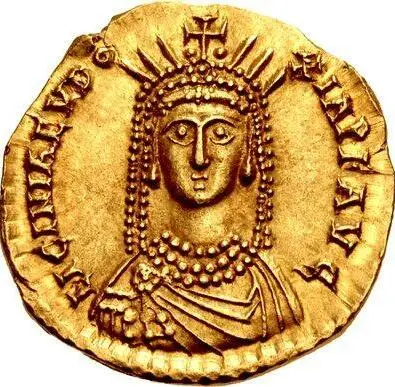
Guldmønt med portræt af Licinia Eudoxia
Gold solidus, Licinia EudoxiaCC BY-SA 2.5
Historical422 – after 462LICINIA EVDOXIA P F AVG

Licinia Eudoxia

Empress

Daughter of Theodosius II. She married Valentinian III at the age of 15 and stood at the centre of the events that ended in the Vandal sack of Rome.

Read the whole story

After the murder of Valentinian, the new emperor, Petronius Maximus, forced her to marry him. According to the chroniclers, in her anger she sent word to the Vandal king Geiseric in Carthage to come to her rescue.

The Vandals came. Maximus was killed as he fled, and Rome was plundered for fourteen days in June 455. Licinia and her daughters were taken to Carthage as prisoners. After seven years she and her youngest daughter Placidia were allowed to travel to Constantinople.

Father
Theodosius II
Daughters
Eudocia and Placidia
See the line from Olaf Gisli to Licinia Eudoxia

46 generations.

  1. 0
  2. 1
  3. 2⚭ Guðrún Birgitta Gísladóttir
  4. 3⚭ Ólafur Pálsson
  5. 4inherited Viðey
  6. 5
  7. 6
  8. 7from Espihóll
  9. 8the bishop's daughter
  10. 9
  11. 10schoolmaster and district sheriff
  12. 11⚭ Gísli Hákonarson
  13. 12dean at Garðar
  14. 13mother of Bishop Guðbrandur
  15. 14
  16. 15⚭ Sigmundur Steinþórsson
  17. 16⚭ Þorleifur Árnason
  18. 17⚭ Björn Jórsalafari
  19. 18The Stórólfshvoll branch
  20. 19· · ·family connection through the Stórólfshvoll branch
  21. 20⚭ Þorsteinn Halldórsson
  22. 21chieftain (goði)
  23. 22Oddi
  24. 23
  25. 24⚭ Loftur Sæmundsson
  26. 25
  27. 26founded Bergen
  28. 27
  29. 28king of Ringerike
  30. 29
  31. 30son of Harald and Snefrid
  32. 31
  33. 32Harald's mother
  34. 33king of Ringerike
  35. 34
  36. 35
  37. 36
  38. 37
  39. 38
  40. 39
  41. 40
  42. 41
  43. 42⚭ Hild
  44. 43Vandal princess
  45. 44
  46. 45
  47. 46
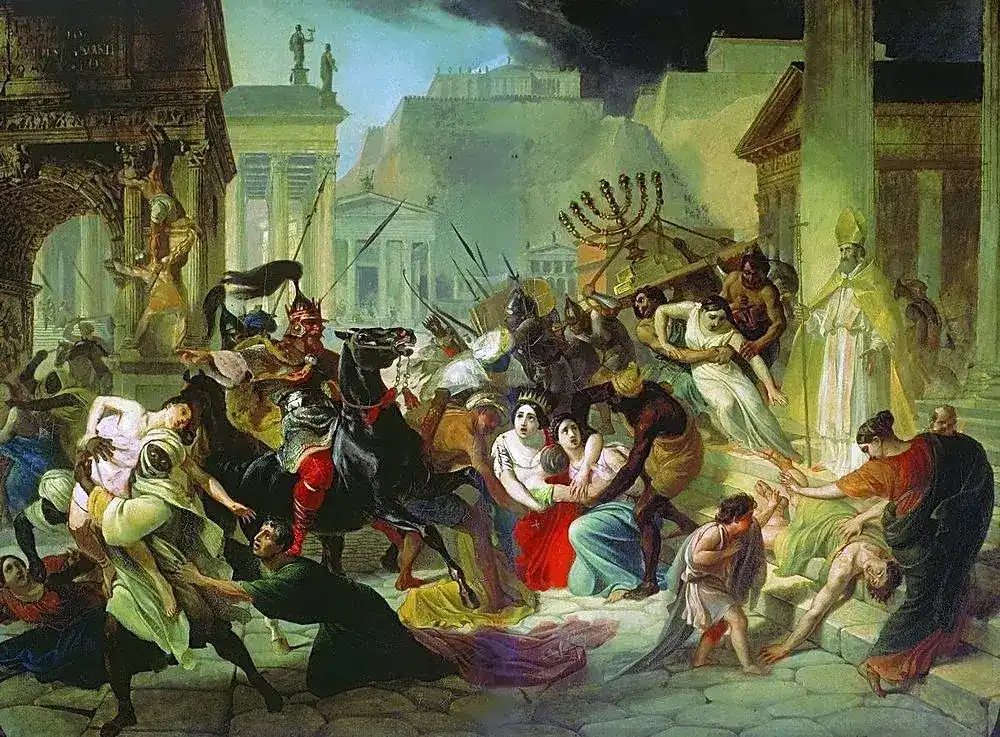
Karl Bryullov, The Sack of Rome by Geiseric in 455 (1833–36)
Karl Bryullov, The Sack of Rome by Geiseric in 455 (1833–36)Public domain
Historical439 – c. 472

Eudocia

Emperor's daughter and Vandal queen

Promised in marriage at five, carried off from Rome at 16, married to the crown prince of the Vandals. She is the link that binds the emperors to the North.

Read the whole story

Eudocia was the eldest daughter of Valentinian III and Licinia Eudoxia. As a child she was betrothed to Huneric, son of the Vandal king Geiseric, as part of an alliance between Rome and the Vandal kingdom in North Africa.

After the sack of Rome in 455 she was taken to Carthage together with her mother and sister. She married Huneric and bore a son, Hilderic. Huneric was an Arian, while Eudocia held fast to the Catholic faith. According to the sources she eventually left Africa and ended her days in Jerusalem.

Karl Bryullov's great painting of Geiseric's sack of Rome portrays the chaos of the summer in which Eudocia's life was turned upside down.

Husband
Huneric, king of the Vandals 477–484
Son
Hilderic
See the line from Olaf Gisli to Eudocia

45 generations.

  1. 0
  2. 1
  3. 2⚭ Guðrún Birgitta Gísladóttir
  4. 3⚭ Ólafur Pálsson
  5. 4inherited Viðey
  6. 5
  7. 6
  8. 7from Espihóll
  9. 8the bishop's daughter
  10. 9
  11. 10schoolmaster and district sheriff
  12. 11⚭ Gísli Hákonarson
  13. 12dean at Garðar
  14. 13mother of Bishop Guðbrandur
  15. 14
  16. 15⚭ Sigmundur Steinþórsson
  17. 16⚭ Þorleifur Árnason
  18. 17⚭ Björn Jórsalafari
  19. 18The Stórólfshvoll branch
  20. 19· · ·family connection through the Stórólfshvoll branch
  21. 20⚭ Þorsteinn Halldórsson
  22. 21chieftain (goði)
  23. 22Oddi
  24. 23
  25. 24⚭ Loftur Sæmundsson
  26. 25
  27. 26founded Bergen
  28. 27
  29. 28king of Ringerike
  30. 29
  31. 30son of Harald and Snefrid
  32. 31
  33. 32Harald's mother
  34. 33king of Ringerike
  35. 34
  36. 35
  37. 36
  38. 37
  39. 38
  40. 39
  41. 40
  42. 41
  43. 42⚭ Hild
  44. 43Vandal princess
  45. 44
  46. 45
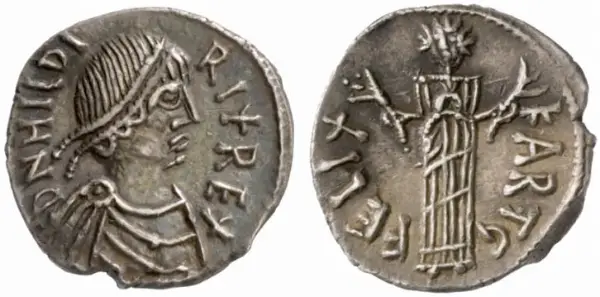
Vandal silver coin struck in Hilderic's name
Vandal silver coin struck in Hilderic's namePublic domain
Historicalc. 460–533 · king 523–530

Hilderic

Hildericus · Hildirix
King of the Vandals and Alans

Grandson of both the Vandal king Geiseric and Emperor Valentinian III. He was a friend of the later emperor Justinian, and his fall became the pretext for Byzantium's conquest of the Vandal kingdom.

Hilderic is historical. The connection to Lejre is known from English genealogy books, not from ancient or medieval sources.

Read the whole story

Hilderic was the son of Huneric and Eudocia. He became king in 523, already over 60 years old. Unlike his predecessors he followed his mother's Catholic faith and ended the persecution of the Catholic Christians.

His good relations with the imperial court in Constantinople made him unpopular among the Vandal nobility. In 530 he was deposed by his cousin Gelimer and thrown into prison. Emperor Justinian used the deposition as grounds for sending the general Belisarius against Carthage in 533, and that same year Hilderic was killed.

The Roman historian Procopius relates that Justinian gave money to Hilderic's children and descendants after the fall of the Vandal kingdom. English genealogy books make his daughter Hildis the wife of King Valdar at Lejre.

Mother
Eudocia
Daughter in the family tree
Hildis, married to Valdar Hroarsson
See the line from Olaf Gisli to Hilderic

44 generations.

  1. 0
  2. 1
  3. 2⚭ Guðrún Birgitta Gísladóttir
  4. 3⚭ Ólafur Pálsson
  5. 4inherited Viðey
  6. 5
  7. 6
  8. 7from Espihóll
  9. 8the bishop's daughter
  10. 9
  11. 10schoolmaster and district sheriff
  12. 11⚭ Gísli Hákonarson
  13. 12dean at Garðar
  14. 13mother of Bishop Guðbrandur
  15. 14
  16. 15⚭ Sigmundur Steinþórsson
  17. 16⚭ Þorleifur Árnason
  18. 17⚭ Björn Jórsalafari
  19. 18The Stórólfshvoll branch
  20. 19· · ·family connection through the Stórólfshvoll branch
  21. 20⚭ Þorsteinn Halldórsson
  22. 21chieftain (goði)
  23. 22Oddi
  24. 23
  25. 24⚭ Loftur Sæmundsson
  26. 25
  27. 26founded Bergen
  28. 27
  29. 28king of Ringerike
  30. 29
  31. 30son of Harald and Snefrid
  32. 31
  33. 32Harald's mother
  34. 33king of Ringerike
  35. 34
  36. 35
  37. 36
  38. 37
  39. 38
  40. 39
  41. 40
  42. 41
  43. 42⚭ Hild
  44. 43Vandal princess
  45. 44
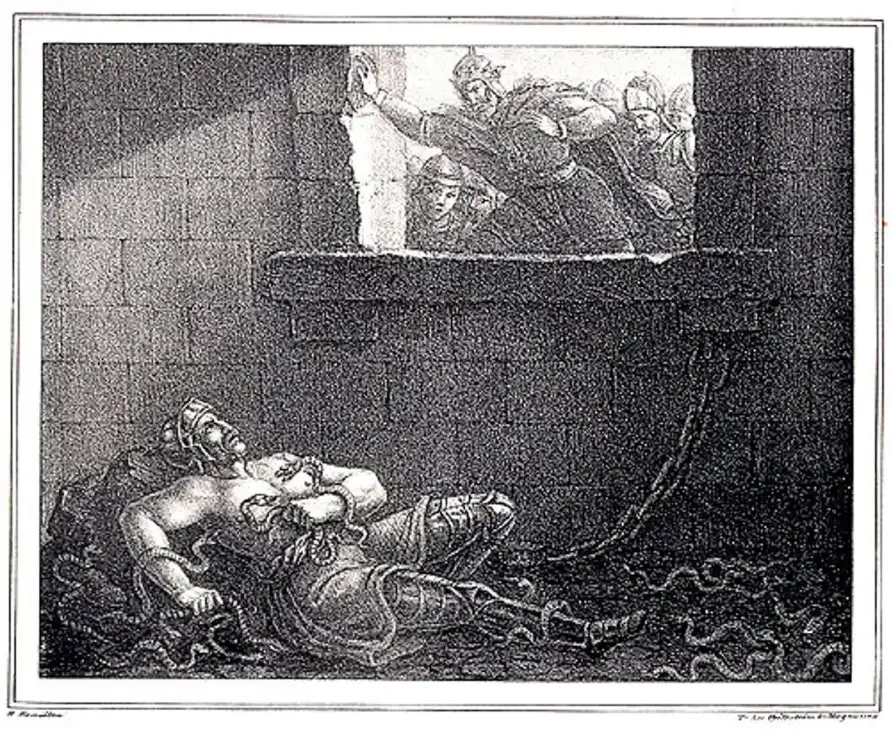
Hugo Hamilton, The Death of Ragnar Lodbrok in the Snake Pit
Viking Age · 800–900

The Vikings

The piglets would grunt if they knew how the old boar suffers.Ragnar's last words in the snake pit, Ragnars saga loðbrókar
Hugo Hamilton, The Death of Ragnar Lodbrok in the Snake Pit

Ragnar Lodbrok and his sons are the centre of the family. From Sigurd Snake-in-the-Eye and King Ælla's daughter Blæja a line runs through the kings of Norway, and from Björn Ironside a line runs through the settler Höfða-Þórður and Snorri Sturluson. Ragnar thus appears twice in the family tree. Even King Ælla, who had Ragnar killed, is our forefather, because his daughter Blæja married Ragnar's son Sigurd.

August Malmström, Ragnar and Kraka (c. 1880)
August Malmström, Ragnar and Kraka (c. 1880)Public domain
Saga9th century

Ragnar Lodbrok (Ragnar Lothbrok)

Ragnarr loðbrók · Ragnar Lothbrok
Viking king and saga hero

The most famous name of the Viking Age. He slew a serpent, married the wise Kraka and died in King Ælla's snake pit in Northumbria.

Read the whole story

The name Lodbrok means “shaggy breeches”. According to the saga he got it because as a young man he tarred and sanded his breeches so that he could kill a serpent coiled around the bower of the jarl's daughter Thora. Thora became his wife. In Saxo one of his wives is the shieldmaiden Ladgerda, the woman the TV series Vikings calls Lagertha.

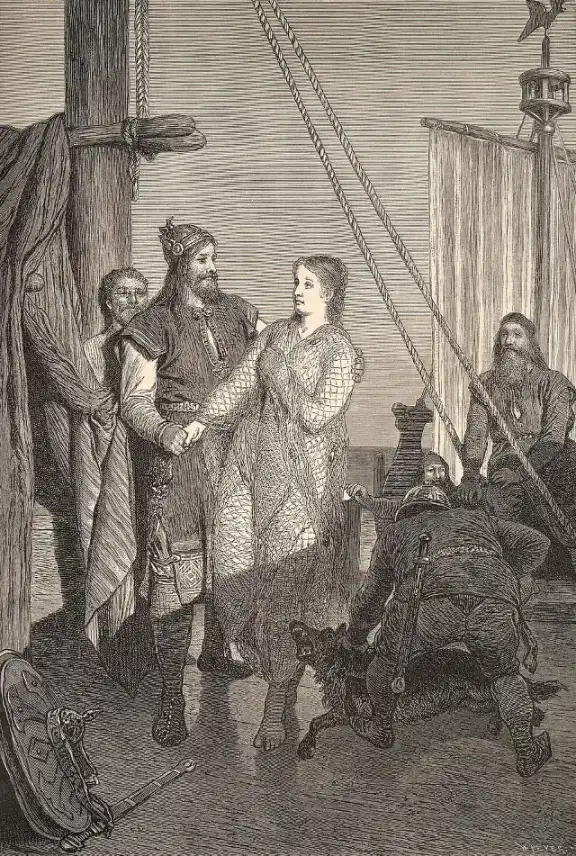
Later he met Kraka, a poor girl from Norway, whom he set a cunning test. She was to come neither clothed nor naked, neither fed nor fasting, neither alone nor in company. She came wrapped in her long hair and a fishing net, having tasted an onion, and with her dog beside her. Kraka turned out to be Aslaug, daughter of Sigurd the Dragon-Slayer, and she became the mother of Björn Ironside and Sigurd Snake-in-the-Eye.

His end is the most famous of all. He sailed against England with only two ships, was taken prisoner by King Ælla and thrown into a pit full of snakes. The 12th-century poem Krákumál puts his last words in his mouth. He laughs as he dies, because he knows that his sons will avenge him and that he will soon be drinking with the Æsir in Valhalla.

Historians still debate whether Ragnar was one man or a fusion of several. A Viking chieftain named Reginherus plundered Paris in 845, and the great army that landed in England in 865 was led by men who called themselves his sons.

Hugo Hamilton, The Death of Ragnar Lodbrok in the Snake Pit
Wives
Thora Town-Hart, Ladgerda, Aslaug (Kraka)
Sons in the family tree
Björn Ironside and Sigurd Snake-in-the-Eye
See the line from Olaf Gisli to Ragnar Lodbrok

Ragnar appears twice in the family tree. Here is the line via Sigurd Snake-in-the-Eye. Both paths contain an uncertain link in the Middle Ages, so the number of generations is approximate.

36 generations.

  1. 0
  2. 1
  3. 2⚭ Guðrún Birgitta Gísladóttir
  4. 3⚭ Ólafur Pálsson
  5. 4inherited Viðey
  6. 5
  7. 6
  8. 7from Espihóll
  9. 8the bishop's daughter
  10. 9
  11. 10schoolmaster and district sheriff
  12. 11⚭ Gísli Hákonarson
  13. 12dean at Garðar
  14. 13mother of Bishop Guðbrandur
  15. 14
  16. 15⚭ Sigmundur Steinþórsson
  17. 16⚭ Þorleifur Árnason
  18. 17⚭ Björn Jórsalafari
  19. 18The Stórólfshvoll branch
  20. 19· · ·family connection through the Stórólfshvoll branch
  21. 20⚭ Þorsteinn Halldórsson
  22. 21chieftain (goði)
  23. 22Oddi
  24. 23
  25. 24⚭ Loftur Sæmundsson
  26. 25
  27. 26founded Bergen
  28. 27
  29. 28king of Ringerike
  30. 29
  31. 30son of Harald and Snefrid
  32. 31
  33. 32Harald's mother
  34. 33king of Ringerike
  35. 34
  36. 35
  37. 36
Björn Järnsidas hög, the burial mound on Munsö in Lake Mälaren
Björn Järnsidas hög, the burial mound on Munsö in Lake MälarenPublic domain
Saga9th century

Björn Ironside

Bjǫrn járnsíða · Björn Ironside
Sea king, son of Ragnar and Aslaug

He was called Ironside because no weapon could bite on him. Frankish chronicles mention a Viking chieftain Berno on the Seine in the 850s, and legend sends him all the way to the Mediterranean.

Read the whole story

According to legend, Björn could not be wounded in battle. Hence the name Ironside. He was the son of Ragnar and Aslaug and one of the leaders of the revenge that followed his father's death.

Contemporary Frankish annals tell of a Viking chieftain Berno who plundered along the Seine in 855–858. Around 859–861 a Viking fleet sailed into the Mediterranean, and later Norman writers have Björn and his foster father Hastein lead the expedition. They attacked the town of Luna in Italy in the belief that it was Rome.

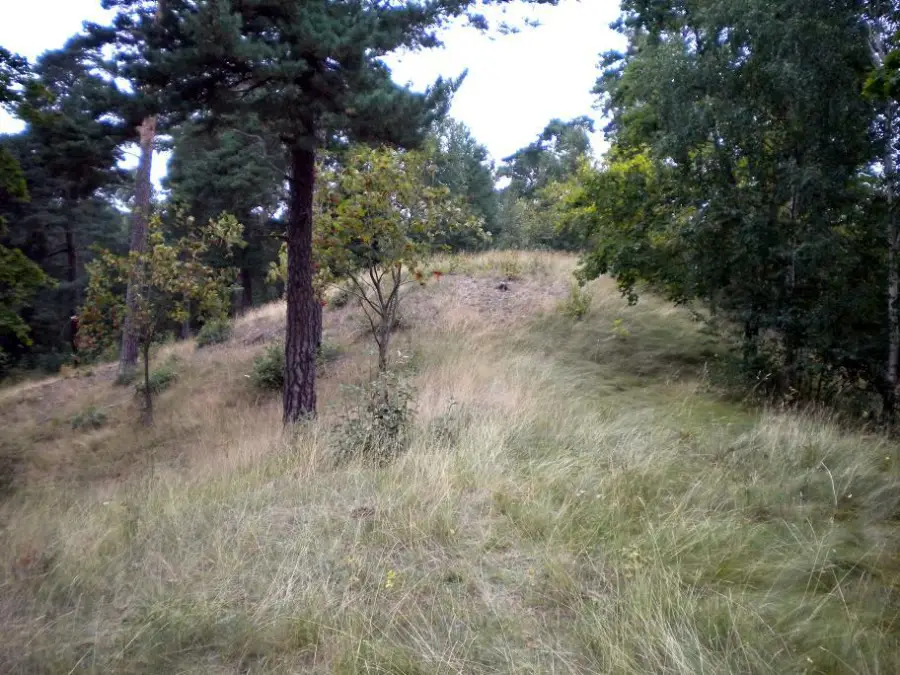
Hastein is said to have tricked his way into the town by pretending to be dead and wishing to be buried in Christian ground. In Swedish tradition Björn became king at Uppsala and forefather of the House of Munsö. Since the 18th century a burial mound on the island of Munsö in Lake Mälaren has been called Björn Järnsidas hög.

Iceland's Landnámabók traces the settler Höfða-Þórður back to Björn, and through him and Snorri Sturluson's mother the family continues on to Iceland.

Contemporary mention
Annales Bertiniani, 855 and 858
Descendant
Höfða-Þórður, settler
See the line from Olaf Gisli to Björn Ironside

35 generations.

  1. 0
  2. 1
  3. 2⚭ Guðrún Birgitta Gísladóttir
  4. 3⚭ Ólafur Pálsson
  5. 4inherited Viðey
  6. 5
  7. 6
  8. 7from Espihóll
  9. 8the bishop's daughter
  10. 9
  11. 10schoolmaster and district sheriff
  12. 11⚭ Gísli Hákonarson
  13. 12dean at Garðar
  14. 13mother of Bishop Guðbrandur
  15. 14
  16. 15⚭ Sigmundur Steinþórsson
  17. 16⚭ Þorleifur Árnason
  18. 17
  19. 18⚭ Grundar-Helga Pétursdóttir
  20. 19knight and royal governor
  21. 20name unknown, possibly a daughter of Einar Þorvaldsson
  22. 21chieftain at Vatnsfjörður
  23. 22⚭ Þorvaldur Vatnsfirðingur
  24. 23
  25. 24mother of the Sturlusons
  26. 25Guðný's mother
  27. 26Helga's mother
  28. 27
  29. 28Bótólfur's mother
  30. 29
  31. 30Ormur's mother
  32. 31brother of Arnór kerlingarnef
  33. 32
  34. 33
  35. 34
  36. 35
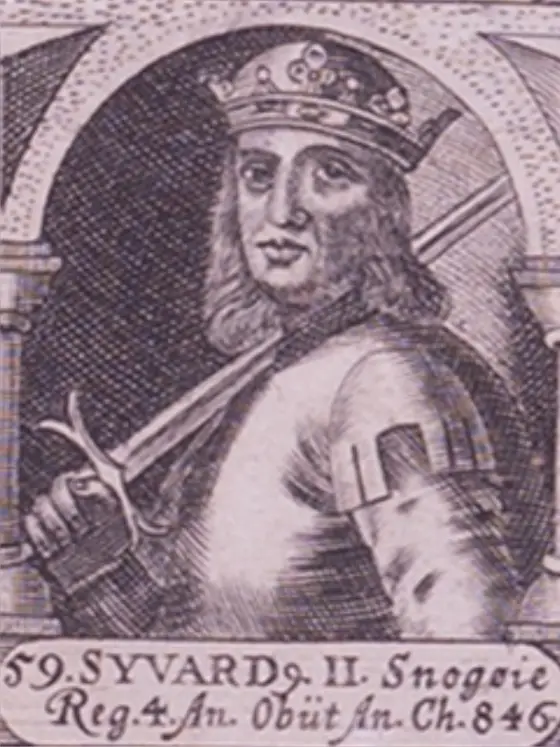
King Sigurd Snake-Eye, from an older Danish series of kings
King Sigurd Snake-Eye, from an older Danish series of kingsPublic domain
Saga9th century

Sigurd Snake-in-the-Eye

Sigurðr ormr í auga
Son of Ragnar, Danish king

He was born with a mark in his eye that looked like a snake biting its own tail. He married the daughter of the king who had killed his father.

Read the whole story

The saga tells that Aslaug foretold that her next son would be born with a sign in his eye. And so it happened. The mark was interpreted as a worm, a snake, and gave him the name Sigurd Snake-in-the-Eye.

Sigurd was there when Ragnar's sons avenged their father in England, and according to the sagas he later inherited the Danish lands. His historical model may be the Danish king Sigfred, who reigned briefly in the 870s. The medieval Norwegian royal house also traced itself back to him.

Through his marriage to Blæja, daughter of King Ælla, the two hostile lineages merge. Their daughter Áslaug became the great-grandmother of Harald Fairhair.

Wife
Blæja, daughter of King Ælla
Daughter in the family tree
Áslaug, great-grandmother of Harald Fairhair
See the line from Olaf Gisli to Sigurd Snake-in-the-Eye

35 generations.

  1. 0
  2. 1
  3. 2⚭ Guðrún Birgitta Gísladóttir
  4. 3⚭ Ólafur Pálsson
  5. 4inherited Viðey
  6. 5
  7. 6
  8. 7from Espihóll
  9. 8the bishop's daughter
  10. 9
  11. 10schoolmaster and district sheriff
  12. 11⚭ Gísli Hákonarson
  13. 12dean at Garðar
  14. 13mother of Bishop Guðbrandur
  15. 14
  16. 15⚭ Sigmundur Steinþórsson
  17. 16⚭ Þorleifur Árnason
  18. 17⚭ Björn Jórsalafari
  19. 18The Stórólfshvoll branch
  20. 19· · ·family connection through the Stórólfshvoll branch
  21. 20⚭ Þorsteinn Halldórsson
  22. 21chieftain (goði)
  23. 22Oddi
  24. 23
  25. 24⚭ Loftur Sæmundsson
  26. 25
  27. 26founded Bergen
  28. 27
  29. 28king of Ringerike
  30. 29
  31. 30son of Harald and Snefrid
  32. 31
  33. 32Harald's mother
  34. 33king of Ringerike
  35. 34
  36. 35
William Bell Scott, The Danes Land in Northumbria (Wallington Hall)
William Bell Scott, The Danes Land in Northumbria (Wallington Hall)Public domain
Historical† 21 March 867

Ælla of Northumbria (Aelle)

Ælle · Aelle
King of Northumbria

The king who, according to the sagas, threw Ragnar into the snake pit. He fell at York when Ragnar's sons came to avenge their father.

Read the whole story

The Anglo-Saxon Chronicle relates that the Northumbrians had deposed their king Osberht and taken Ælla as king, a king with no right to the throne. When the Great Heathen Army captured York in November 866, the two rivals joined forces against the Vikings.

On 21 March 867 they attacked the city, and both kings fell along with a large part of the Northumbrians. The Norse sagas tell a crueller story, namely that Ragnar's sons performed the blood eagle ritual on Ælla. Many historians doubt that the ritual ever took place.

According to the Icelandic genealogical registers, Ælla had a daughter, Blæja, who married Ragnar's son Sigurd. The Gísli family thus descends both from Ragnar and from the king who killed him.

Source
The Anglo-Saxon Chronicle
Daughter
Blæja, married to Sigurd Snake-in-the-Eye
See the line from Olaf Gisli to Ælla of Northumbria

36 generations.

  1. 0
  2. 1
  3. 2⚭ Guðrún Birgitta Gísladóttir
  4. 3⚭ Ólafur Pálsson
  5. 4inherited Viðey
  6. 5
  7. 6
  8. 7from Espihóll
  9. 8the bishop's daughter
  10. 9
  11. 10schoolmaster and district sheriff
  12. 11⚭ Gísli Hákonarson
  13. 12dean at Garðar
  14. 13mother of Bishop Guðbrandur
  15. 14
  16. 15⚭ Sigmundur Steinþórsson
  17. 16⚭ Þorleifur Árnason
  18. 17⚭ Björn Jórsalafari
  19. 18The Stórólfshvoll branch
  20. 19· · ·family connection through the Stórólfshvoll branch
  21. 20⚭ Þorsteinn Halldórsson
  22. 21chieftain (goði)
  23. 22Oddi
  24. 23
  25. 24⚭ Loftur Sæmundsson
  26. 25
  27. 26founded Bergen
  28. 27
  29. 28king of Ringerike
  30. 29
  31. 30son of Harald and Snefrid
  32. 31
  33. 32Harald's mother
  34. 33king of Ringerike
  35. 34
  36. 35⚭ Sigurd Snake-in-the-Eye
  37. 36
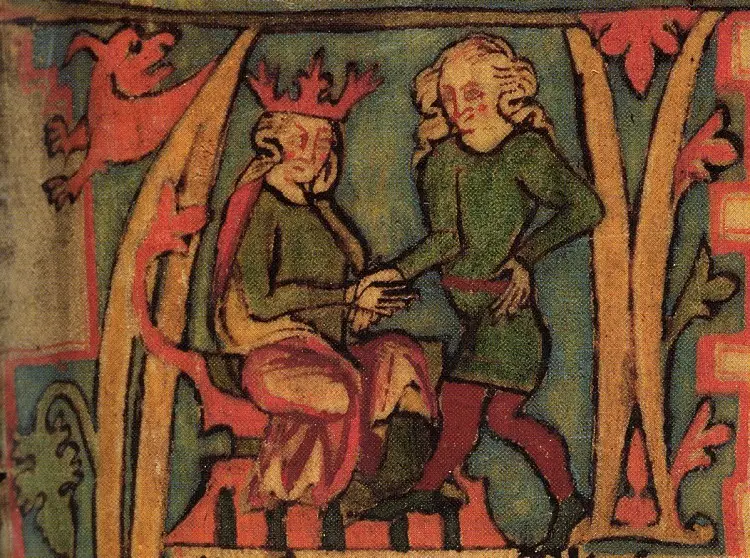
Flateyjarbók (1387–94), initial with Harald Fairhair and Halfdan the Black. The manuscript was in the family's possession until 1647
Norway · 870–1103

The kings of Norway

He swore that he would neither cut nor comb his hair until he had brought all Norway under his rule.Heimskringla, the Saga of Harald Fairhair (freely rendered)
Flateyjarbók (1387–94), initial with Harald Fairhair and Halfdan the Black. The manuscript was in the family's possession until 1647

According to the sagas' genealogy, Sigurd Hart was a daughter's son of Sigurd Snake-in-the-Eye, and his daughter Ragnhild became the mother of Harald Fairhair. From Harald the line runs through four generations of Norwegian petty kings and kings to Harald Hardrada and Magnus Barefoot, whose daughter Þóra was married into Iceland.

Flateyjarbók (1387–94), initial with Harald Fairhair and Halfdan the Black. The manuscript was in the family's possession until 1647
Flateyjarbók (1387–94), initial with Harald Fairhair and Halfdan the Black. The manuscript was in the family's possession until 1647Public domain
Sagac. 850–932

Harald Fairhair

First king of all Norway

He vowed not to cut his hair until he was king over all Norway. Almost all later Norwegian kings traced their descent from him.

Read the whole story

Harald was the son of Halfdan the Black and Ragnhild. According to Heimskringla he proposed to Gyda, who replied that she would only marry him once he was king over all Norway. He vowed neither to cut nor to comb his hair until he had succeeded.

After the Battle of Hafrsfjord around 872 he is regarded as the first king of all Norway, and only then did he have his hair cut. His harsh rule drove many great men to emigrate, and according to the sagas this was an important reason for the settlement of Iceland. He had many sons, and almost all later Norwegian kings traced their descent from him.

Ragnhild was the daughter of Sigurd Hart. After her father's death she was carried off by a berserker, but King Halfdan the Black took her and married her. Heimskringla relates that she dreamt she pulled a thorn out of her dress, and it grew into an enormous tree whose root was blood-red, its trunk green and its branches white, and which spread out over all Norway.

The dream was interpreted as an omen of her son, Harald Fairhair.

Mother
Ragnhild, daughter of Sigurd Snake-in-the-Eye's daughter's son
Son in the family tree
Sigurd Rise
Source
Heimskringla
See the line from Olaf Gisli to Harald Fairhair

31 generations.

  1. 0
  2. 1
  3. 2⚭ Guðrún Birgitta Gísladóttir
  4. 3⚭ Ólafur Pálsson
  5. 4inherited Viðey
  6. 5
  7. 6
  8. 7from Espihóll
  9. 8the bishop's daughter
  10. 9
  11. 10schoolmaster and district sheriff
  12. 11⚭ Gísli Hákonarson
  13. 12dean at Garðar
  14. 13mother of Bishop Guðbrandur
  15. 14
  16. 15⚭ Sigmundur Steinþórsson
  17. 16⚭ Þorleifur Árnason
  18. 17⚭ Björn Jórsalafari
  19. 18The Stórólfshvoll branch
  20. 19· · ·family connection through the Stórólfshvoll branch
  21. 20⚭ Þorsteinn Halldórsson
  22. 21chieftain (goði)
  23. 22Oddi
  24. 23
  25. 24⚭ Loftur Sæmundsson
  26. 25
  27. 26founded Bergen
  28. 27
  29. 28king of Ringerike
  30. 29
  31. 30son of Harald and Snefrid
  32. 31
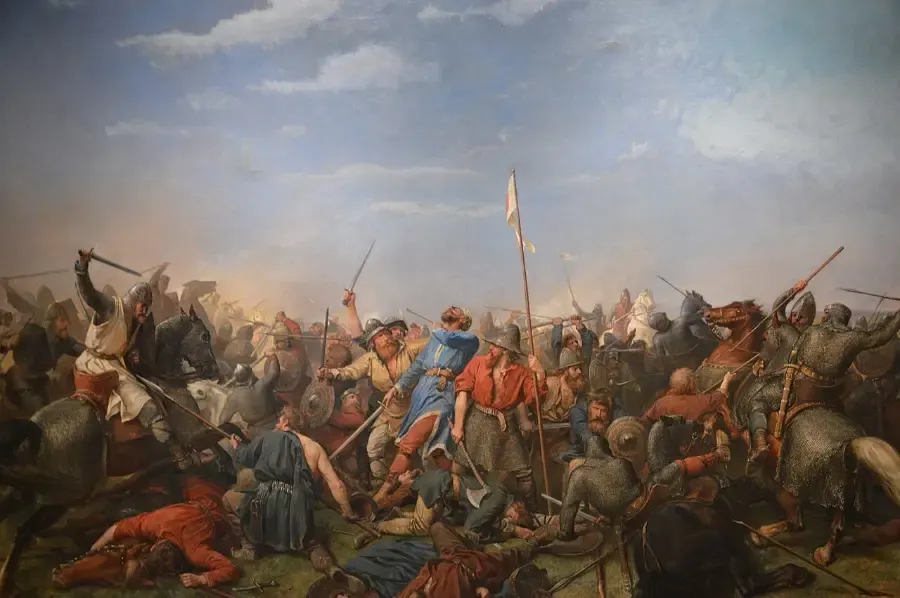
Peter Nicolai Arbo, The Battle of Stamford Bridge 1066, where Harald Hardrada fell (1870)
Peter Nicolai Arbo, The Battle of Stamford Bridge 1066, where Harald Hardrada fell (1870)Public domain
Historical1015–1066 · king 1046–1066

Harald Hardrada

Varangian commander and king of Norway

From the Battle of Stiklestad by way of Kiev and Constantinople to the throne of Norway and death at Stamford Bridge. His fall is regarded as the end of the Viking Age.

Read the whole story

Harald Sigurdsson was the half-brother of Olaf the Saint. At fifteen he fought at Stiklestad in 1030 and fled, wounded, through Sweden to Kiev. He entered the service of the Varangian Guard in Constantinople, fought in Sicily and Bulgaria and amassed an enormous fortune.

He married Ellisif, daughter of the Grand Prince of Kiev, and became king of Norway in 1046. For years he waged war against Denmark. In 1066 he landed in England to take the throne and fell at Stamford Bridge on 25 September.

His death is often regarded as the end of the Viking Age.

Father
Sigurd Syr
Half-brother
Olaf the Saint
Son in the family tree
Olaf the Peaceful
See the line from Olaf Gisli to Harald Hardrada

27 generations.

  1. 0
  2. 1
  3. 2⚭ Guðrún Birgitta Gísladóttir
  4. 3⚭ Ólafur Pálsson
  5. 4inherited Viðey
  6. 5
  7. 6
  8. 7from Espihóll
  9. 8the bishop's daughter
  10. 9
  11. 10schoolmaster and district sheriff
  12. 11⚭ Gísli Hákonarson
  13. 12dean at Garðar
  14. 13mother of Bishop Guðbrandur
  15. 14
  16. 15⚭ Sigmundur Steinþórsson
  17. 16⚭ Þorleifur Árnason
  18. 17⚭ Björn Jórsalafari
  19. 18The Stórólfshvoll branch
  20. 19· · ·family connection through the Stórólfshvoll branch
  21. 20⚭ Þorsteinn Halldórsson
  22. 21chieftain (goði)
  23. 22Oddi
  24. 23
  25. 24⚭ Loftur Sæmundsson
  26. 25
  27. 26founded Bergen
  28. 27
Christian Krohg, “When the sun rose, Magnus and his men went ashore”, Magnus Barefoot's last morning in Ulster (1899)
Christian Krohg, “When the sun rose, Magnus and his men went ashore”, Magnus Barefoot's last morning in Ulster (1899)Public domain
Historical1073–1103 · king 1093–1103

Magnus Barefoot

King of Norway

The Viking king who went about bare-legged in Scottish dress and sought to create a Norwegian realm around the Irish Sea.

Read the whole story

Magnus Olafsson was king of Norway 1093–1103. He got the byname Barefoot because, after an expedition to the west, he dressed like the Scots, with bare legs. He led campaigns to Orkney, the Hebrides, the Isle of Man, Wales and Ireland and sought to create a Norwegian realm around the Irish Sea.

He fell in Ulster in 1103, aged 30. His illegitimate daughter Þóra was married into Iceland.

Father
Olaf the Peaceful
Daughter in the family tree
Þóra, mother of Jón Loftsson
See the line from Olaf Gisli to Magnus Barefoot

25 generations.

  1. 0
  2. 1
  3. 2⚭ Guðrún Birgitta Gísladóttir
  4. 3⚭ Ólafur Pálsson
  5. 4inherited Viðey
  6. 5
  7. 6
  8. 7from Espihóll
  9. 8the bishop's daughter
  10. 9
  11. 10schoolmaster and district sheriff
  12. 11⚭ Gísli Hákonarson
  13. 12dean at Garðar
  14. 13mother of Bishop Guðbrandur
  15. 14
  16. 15⚭ Sigmundur Steinþórsson
  17. 16⚭ Þorleifur Árnason
  18. 17⚭ Björn Jórsalafari
  19. 18The Stórólfshvoll branch
  20. 19· · ·family connection through the Stórólfshvoll branch
  21. 20⚭ Þorsteinn Halldórsson
  22. 21chieftain (goði)
  23. 22Oddi
  24. 23
  25. 24⚭ Loftur Sæmundsson
  26. 25
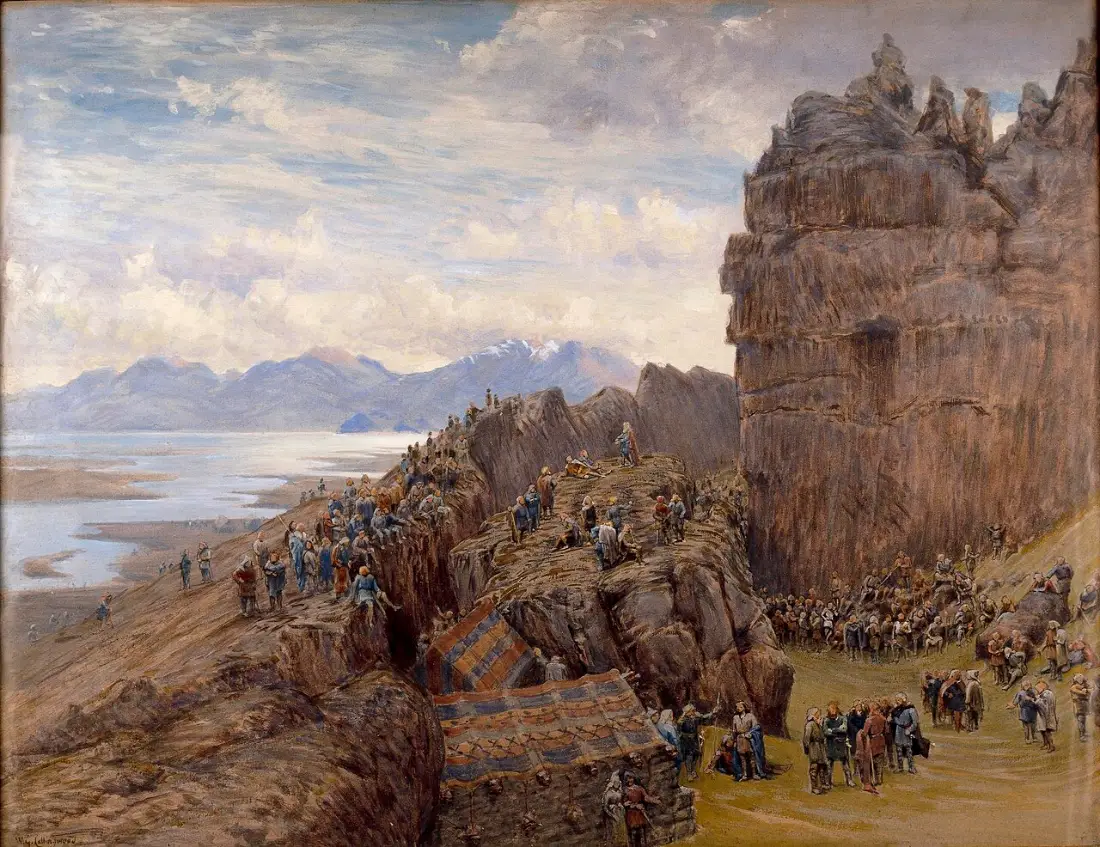
W. G. Collingwood, The Althing at Þingvellir (c. 1897)
Iceland · 870–1250

Settlement and saga age

Þórður hét maður ágætur; hann var son Bjarnar byrðusmjörs, Hróaldssonar hryggs, Bjarnarsonar járnsíðu, Ragnarssonar loðbrókar.Landnámabók on Höfða-Þórður
W. G. Collingwood, The Althing at Þingvellir (c. 1897)

The settler Höfða-Þórður came to Skagafjörður around the year 900. His descendants and the king's daughter Þóra from Norway became the ancestors of the great chieftain families of the saga age: the Oddaverjar, the Sturlungs and the Seldælir. Here stand the scholars, the chieftains and the physician from Eyri.

W. G. Collingwood, The Althing at Þingvellir (c. 1897)
W. G. Collingwood, The Althing at Þingvellir (c. 1897)Public domain
Saga9th–10th century

Höfða-Þórður Bjarnarson

Settler in Skagafjörður

Descendant of Björn Ironside. He took land at Höfðaströnd in Skagafjörður and, according to Landnámabók, had eleven sons and eight daughters.

Read the whole story

Landnámabók traces his lineage back in a single breath: Þórður was the son of Björn byrðusmjör, son of Hróaldr hryggr, son of Björn Ironside, son of Ragnar Lodbrok. He took the land at Höfðaströnd in Skagafjörður, from Unadalsá to Hrolleifsdalsá, and built his farm at Höfði. According to Landnámabók, his wife Þorgerður was a daughter's daughter of the Irish king Kjarval.

They had eleven sons and eight daughters, and many of Iceland's great families reckon their descent from them, among them the Vinland voyager Þorfinnur karlsefni, three bishops and the Sturlung family. Landnámabók itself traces the line from his son Björn down to “Guðný, mother of the Sturlusons”, that is, to Snorri Sturluson.

Source
Landnámabók
Land
Höfðaströnd, Skagafjörður
See the line from Olaf Gisli to Höfða-Þórður Bjarnarson

32 generations.

  1. 0
  2. 1
  3. 2⚭ Guðrún Birgitta Gísladóttir
  4. 3⚭ Ólafur Pálsson
  5. 4inherited Viðey
  6. 5
  7. 6
  8. 7from Espihóll
  9. 8the bishop's daughter
  10. 9
  11. 10schoolmaster and district sheriff
  12. 11⚭ Gísli Hákonarson
  13. 12dean at Garðar
  14. 13mother of Bishop Guðbrandur
  15. 14
  16. 15⚭ Sigmundur Steinþórsson
  17. 16⚭ Þorleifur Árnason
  18. 17
  19. 18⚭ Grundar-Helga Pétursdóttir
  20. 19knight and royal governor
  21. 20name unknown, possibly a daughter of Einar Þorvaldsson
  22. 21chieftain at Vatnsfjörður
  23. 22⚭ Þorvaldur Vatnsfirðingur
  24. 23
  25. 24mother of the Sturlusons
  26. 25Guðný's mother
  27. 26Helga's mother
  28. 27
  29. 28Bótólfur's mother
  30. 29
  31. 30Ormur's mother
  32. 31brother of Arnór kerlingarnef
  33. 32
Sæmundur fróði rides home from Paris on the Devil in the shape of a seal and strikes it with the Psalter as Iceland comes into view
Sæmundur fróði rides home from Paris on the Devil in the shape of a seal and strikes it with the Psalter as Iceland comes into viewAI illustration
Historical1056–1133

Sæmundur fróði

One of Iceland's earliest scholars, a sorcerer in legend

Priest and chieftain at Oddi and one of Iceland's earliest scholars educated abroad. Folk legend made him the sorcerer who rode across the sea on the Devil.

Read the whole story

Sæmundur Sigfússon, known as fróði, “the learned”, was born in 1056 and was priest and chieftain at the great farm of Oddi in South Iceland. Iceland's chieftains were called goðar and had seats at the Althing. He studied abroad and became one of Iceland's earliest scholars educated abroad. He wrote a Latin history of the Norwegian kings, which is lost, and helped introduce the tithe in 1096–97.

In folk legend he became a sorcerer. He is said to have studied at the Black School under the Devil himself and tricked his way free. To reach home to Oddi in time, he rode across the sea on the Devil in the shape of a seal, and just before they reached land he struck the seal on the head with the Book of Psalms.

A statue of Sæmundur on the seal stands in front of the University of Iceland in Reykjavík. He died in 1133.

Farm
Oddi in Rangárvellir
Grandson
Jón Loftsson
See the line from Olaf Gisli to Sæmundur fróði

25 generations.

  1. 0
  2. 1
  3. 2⚭ Guðrún Birgitta Gísladóttir
  4. 3⚭ Ólafur Pálsson
  5. 4inherited Viðey
  6. 5
  7. 6
  8. 7from Espihóll
  9. 8the bishop's daughter
  10. 9
  11. 10schoolmaster and district sheriff
  12. 11⚭ Gísli Hákonarson
  13. 12dean at Garðar
  14. 13mother of Bishop Guðbrandur
  15. 14
  16. 15⚭ Sigmundur Steinþórsson
  17. 16⚭ Þorleifur Árnason
  18. 17⚭ Björn Jórsalafari
  19. 18The Stórólfshvoll branch
  20. 19· · ·family connection through the Stórólfshvoll branch
  21. 20⚭ Þorsteinn Halldórsson
  22. 21chieftain (goði)
  23. 22Oddi
  24. 23
  25. 24⚭ Þóra Magnúsdóttir
  26. 25
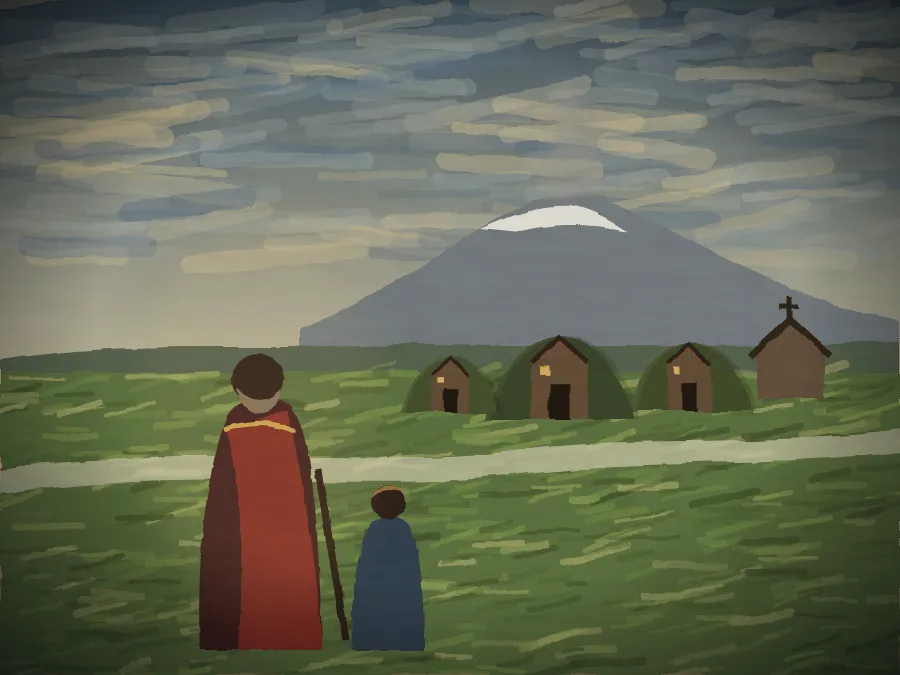
Jón Loftsson at Oddi with the boy Snorri Sturluson, who grew up in his household. Hekla in the background
Jón Loftsson at Oddi with the boy Snorri Sturluson, who grew up in his household. Hekla in the backgroundAI illustration
Historical1124–1197

Jón Loftsson

Chieftain at Oddi, grandson of a king

Grandson of King Magnus Barefoot and the most powerful Icelander of his time. He fostered the young Snorri Sturluson.

Read the whole story

Jón was born in 1124, the son of the priest Loftur Sæmundsson and the king's daughter Þóra. He grew up at Konungahella in Norway and came to Iceland at the age of eleven. He became the most powerful chieftain in the land, held all the chieftaincies in Rangárþing and was regarded as the wisest man in the country.

In the dispute over church property in 1179 he stood firm against Bishop Þorlákur the Saint and won. In 1181 he reconciled Hvamm-Sturla with an opponent and offered to foster Sturla's three-year-old son Snorri. Snorri Sturluson grew up at Oddi until he was nineteen and received his learning there.

Jón died in 1197.

Mother
Þóra, daughter of Magnus Barefoot
Paternal grandfather
Sæmundur fróði
Son in the family tree
Sæmundur Jónsson
See the line from Olaf Gisli to Jón Loftsson

23 generations.

  1. 0
  2. 1
  3. 2⚭ Guðrún Birgitta Gísladóttir
  4. 3⚭ Ólafur Pálsson
  5. 4inherited Viðey
  6. 5
  7. 6
  8. 7from Espihóll
  9. 8the bishop's daughter
  10. 9
  11. 10schoolmaster and district sheriff
  12. 11⚭ Gísli Hákonarson
  13. 12dean at Garðar
  14. 13mother of Bishop Guðbrandur
  15. 14
  16. 15⚭ Sigmundur Steinþórsson
  17. 16⚭ Þorleifur Árnason
  18. 17⚭ Björn Jórsalafari
  19. 18The Stórólfshvoll branch
  20. 19· · ·family connection through the Stórólfshvoll branch
  21. 20⚭ Þorsteinn Halldórsson
  22. 21chieftain (goði)
  23. 22Oddi
  24. 23
Hrafnseyri in Arnarfjörður, the old Eyri, where Hrafn lived and was killed
Hrafnseyri in Arnarfjörður, the old Eyri, where Hrafn lived and was killedPublic domain
Historicalc. 1166–1213

Hrafn Sveinbjarnarson

Physician and pilgrim at Eyri

The most famous Icelandic physician of the Middle Ages. He treated everyone free of charge, gave walrus tusks to Thomas Becket's tomb and was beheaded by his enemy.

Read the whole story

Hrafn was born around 1166 and lived at Eyri in Arnarfjörður. He was the most famous Icelandic physician of the Middle Ages. He travelled to Norway and on to England, where he gave walrus tusks to Thomas Becket's tomb in Canterbury, and to Rome and Santiago de Compostela.

He probably learned medicine in the tradition of the school of Salerno. His saga says that everyone was welcome at his home, and that he let everyone sail free of charge across Arnarfjörður and Breiðafjörður, “as if there were a bridge over both fjords”. He treated all the sick and never took payment.

He fell into a feud with Þorvaldur Vatnsfirðingur, who at last crossed the mountain Gláma in a storm and had him beheaded at Eyri on 4 March 1213. The farm has since been called Hrafnseyri, and he is said to lie beneath a memorial stone there. Later Jón Sigurðsson, leader of Iceland's struggle for independence, was born on the same farm.

Farm
Eyri, later Hrafnseyri, in Arnarfjörður
Source
Hrafns saga Sveinbjarnarsonar
See the line from Olaf Gisli to Hrafn Sveinbjarnarson

22 generations.

  1. 0
  2. 1
  3. 2⚭ Guðrún Birgitta Gísladóttir
  4. 3⚭ Ólafur Pálsson
  5. 4inherited Viðey
  6. 5
  7. 6
  8. 7from Espihóll
  9. 8the bishop's daughter
  10. 9
  11. 10schoolmaster and district sheriff
  12. 11⚭ Gísli Hákonarson
  13. 12dean at Garðar
  14. 13mother of Bishop Guðbrandur
  15. 14
  16. 15⚭ Sigmundur Steinþórsson
  17. 16⚭ Þorleifur Árnason
  18. 17
  19. 18⚭ Grundar-Helga Pétursdóttir
  20. 19knight and royal governor
  21. 20Eiríkur's father
  22. 21
  23. 22
Christian Krohg, Snorri Sturluson
Christian Krohg, Snorri SturlusonPublic domain
Historical1179–1241

Snorri Sturluson

Saga writer and chieftain at Reykholt

Iceland's greatest saga writer. His works are among our most important sources for Norse mythology and the kings of Norway.

Read the whole story

Snorri was born in 1179, the son of Hvamm-Sturla and Guðný Böðvarsdóttir. At the age of three he was fostered by Jón Loftsson at Oddi, the most powerful chieftain in the land, and grew up in Iceland's most distinguished centre of learning. He himself became one of the richest and most powerful men in the country, lived at Reykholt and was twice Lawspeaker.

He wrote Snorri's Edda, a handbook of skaldic poetry that is also the most important source for Norse mythology, and Heimskringla, the sagas of the kings of Norway from Odin to 1177. He is also often regarded as the author of Egils saga. Many of the kings and legendary figures in this family tree are known to us precisely from his books.

He became entangled in the Norwegian king's plans to gain power over Iceland, and in 1241 Gissur Þorvaldsson had him killed in the cellar at Reykholt. His last words are said to have been “Eigi skal höggva!”, “Do not strike!”. Snorralaug, his bathing pool, can still be seen at Reykholt.

Works
Snorri's Edda, Heimskringla
Farm
Reykholt in Borgarfjörður
Daughter in the family tree
Þórdís Snorradóttir
See the line from Olaf Gisli to Snorri Sturluson

23 generations.

  1. 0
  2. 1
  3. 2⚭ Guðrún Birgitta Gísladóttir
  4. 3⚭ Ólafur Pálsson
  5. 4inherited Viðey
  6. 5
  7. 6
  8. 7from Espihóll
  9. 8the bishop's daughter
  10. 9
  11. 10schoolmaster and district sheriff
  12. 11⚭ Gísli Hákonarson
  13. 12dean at Garðar
  14. 13mother of Bishop Guðbrandur
  15. 14
  16. 15⚭ Sigmundur Steinþórsson
  17. 16⚭ Þorleifur Árnason
  18. 17
  19. 18⚭ Grundar-Helga Pétursdóttir
  20. 19knight and royal governor
  21. 20name unknown, possibly a daughter of Einar Þorvaldsson
  22. 21chieftain at Vatnsfjörður
  23. 22⚭ Þorvaldur Vatnsfirðingur
  24. 23
Víðidalstunga, the farm of Þorleifur Árnason and Jón Sigmundsson
Iceland and Greenland · 1300–1520

Knights, pilgrims and Greenland

… sigldu til Jórsalalands og heimsóttu Vors Herra gröf.On Björn Jórsalafari and Solveig, 1406
Víðidalstunga, the farm of Þorleifur Árnason and Jón Sigmundsson

In the late Middle Ages the family are wealthy landowners, knights and lawmen. They travel to Greenland, Rome and Jerusalem, are married in the last known church of Norse Greenland and quarrel with the bishops. Their dealings survive in letters and annals.

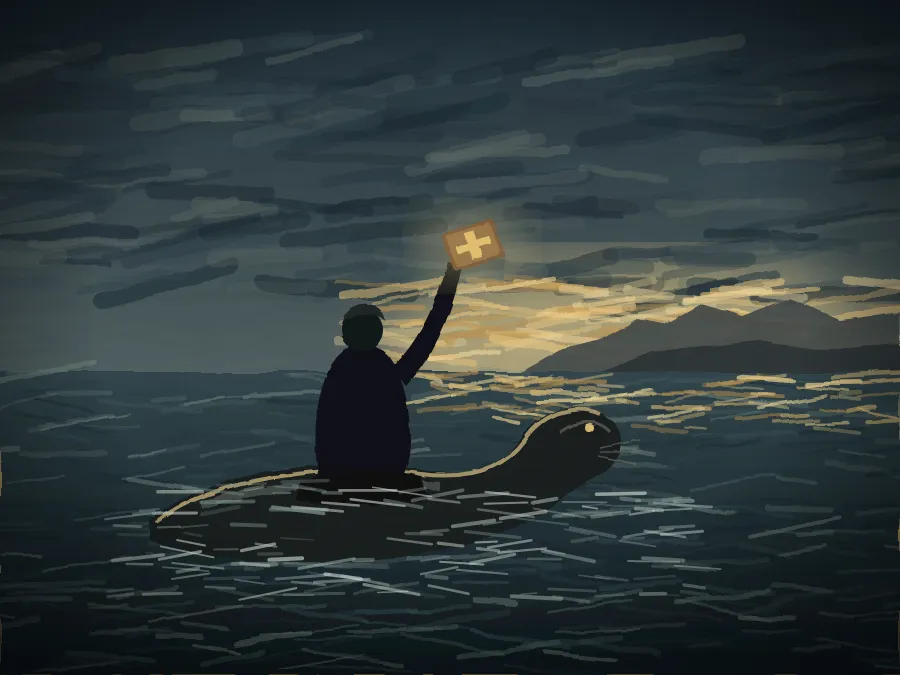
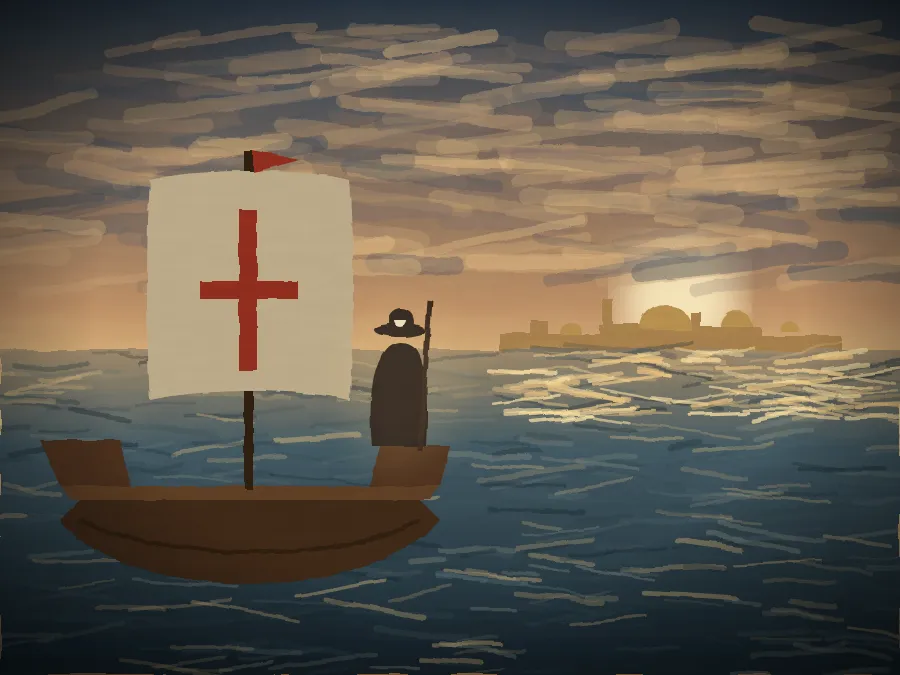
Björn Jórsalafari sails towards the Holy Land as a pilgrim
Björn Jórsalafari sails towards the Holy Land as a pilgrimAI illustration
Documentedc. 1350–1415

Björn Jórsalafari

Björn Einarsson · and Solveig Þorsteinsdóttir
Greenland voyager and Jerusalem pilgrim

He drifted to Greenland and was stranded there for two years, and together with his wife Solveig he travelled to Rome and Jerusalem. No Icelander of his time had seen more of the world.

Read the whole story

Björn Einarsson was born around 1350 and was one of the richest and most widely travelled Icelanders of his day. He was the illegitimate son of Einar Eiríksson of Vatnsfjörður and so inherited nothing, but he made a fortune early on. In 1385 he drifted with four ships to Greenland and was stranded there for two years.

The Greenlanders made him tax collector in Eiriksfjord, and he received 260 legs of lamb as tax. Back home he bought Vatnsfjörður for five times its valuation. Because trade with Greenland required the king's permission, he was brought to trial in Bergen in 1389, but was acquitted.

In 1406 he and Solveig set out on a pilgrimage to Rome and Jerusalem. He then continued alone to Santiago de Compostela, where he lay sick for a month, and travelled home through France and England, stopping at Thomas Becket's tomb in Canterbury. He died in Hvalfjörður in 1415 and was buried at Skálholt.

His travel book about Greenland is lost, but fragments survive in later annals. Solveig was married to Björn Jórsalafari and accompanied him on almost all his journeys, both to Greenland and to Jerusalem. The annal relates that in 1401 she sailed alone to Norway on a ship that Björn owned in halves with the church of Skálholt.

In 1406 the couple travelled to Rome and from there via Venice to Jerusalem, where they visited the tomb of Christ. In Venice they parted: Solveig travelled north to Norway, while Björn continued to Santiago de Compostela. She is mentioned in a judgement of 1420, preserved as an original letter, in which her son-in-law Þorleifur Árnason pleads a case on her behalf concerning the farm Grund in Eyjafjörður.

In a deed of gift from 1433 she gives half of Vatnsfjörður to her daughter's son Björn Þorleifsson. Her parents are not known by name.

Wife
Solveig Þorsteinsdóttir
Daughter
Vatnsfjarðar-Kristín
Sources
Annals, Diplomatarium Islandicum
See the line from Olaf Gisli to Björn Jórsalafari

17 generations.

  1. 0
  2. 1
  3. 2⚭ Guðrún Birgitta Gísladóttir
  4. 3⚭ Ólafur Pálsson
  5. 4inherited Viðey
  6. 5
  7. 6
  8. 7from Espihóll
  9. 8the bishop's daughter
  10. 9
  11. 10schoolmaster and district sheriff
  12. 11⚭ Gísli Hákonarson
  13. 12dean at Garðar
  14. 13mother of Bishop Guðbrandur
  15. 14
  16. 15⚭ Sigmundur Steinþórsson
  17. 16⚭ Þorleifur Árnason
  18. 17
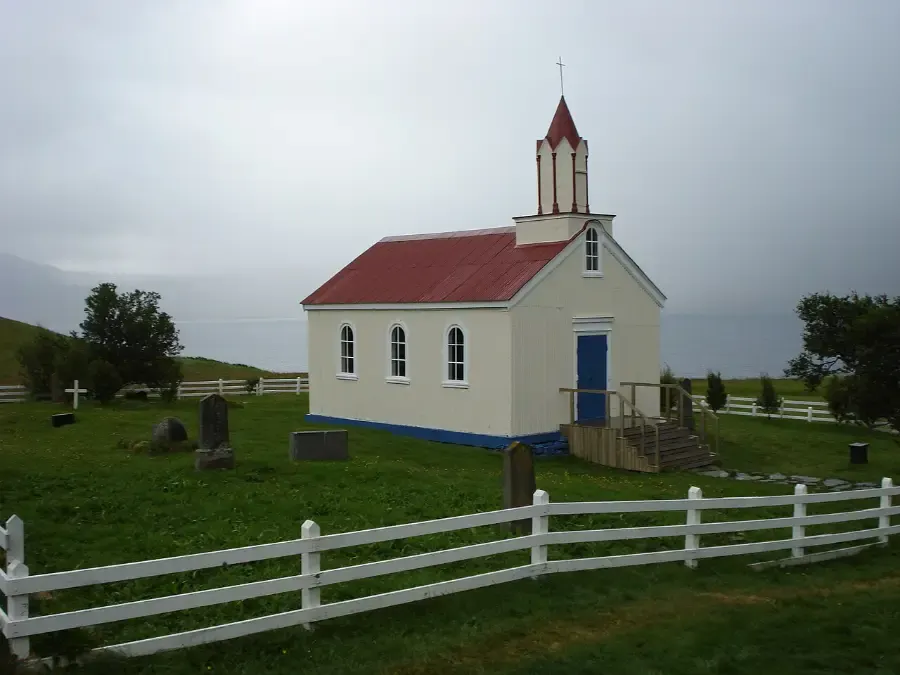
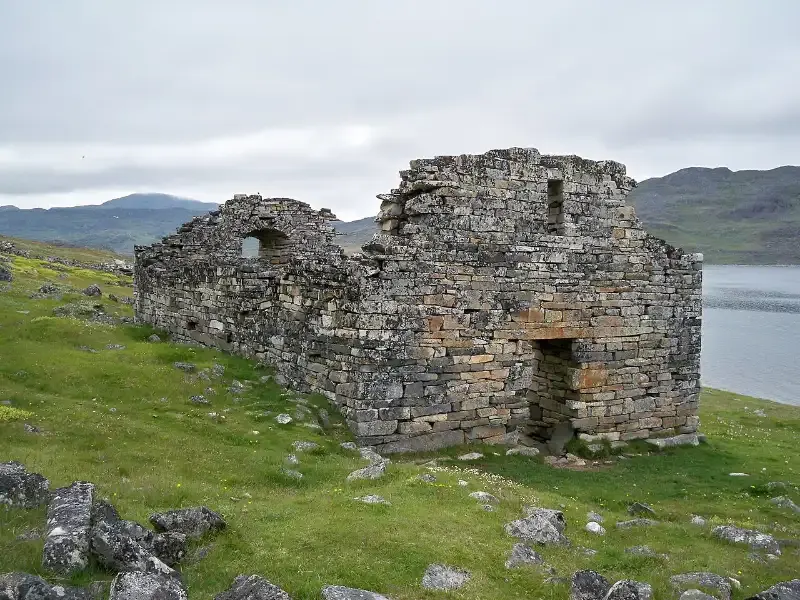
Hvalsey Church in Greenland, where the wedding took place on 16 September 1408
Hvalsey Church in Greenland, where the wedding took place on 16 September 1408CC0
Documented16 September 1408

The wedding at Hvalsey

Sigríður Björnsdóttir and Þorsteinn Ólafsson
The last written source on the Norse in Greenland

Two shipwrecked Icelanders were married in a stone church near the southern tip of Greenland. The wedding is the last we hear of the Norse colony before it vanished.

Read the whole story

Sigríður was the daughter of Björn ríki Brynjólfsson of Stóru-Akrar. In 1406 she was on her way home from Norway with her kinsman Sæmundur Oddsson when the ship drifted to Greenland and was wrecked. Among the shipwrecked was Þorsteinn Ólafsson.

On 16 September 1408 Sigríður and Þorsteinn were married in Hvalsey Church in the Eastern Settlement. The testimonies of the wedding are the last written sources on the Norse in Greenland before the colony disappeared. The church ruin still stands and is the best-preserved Norse ruin in Greenland.

The couple did not return home to Iceland until around 1413 and settled at Akrar. Þorsteinn became lawman in 1421 and died in 1435. Björn ríki, “the rich”, was a wealthy farmer at Stóru-Akrar in Skagafjörður, the family seat since the time of his grandfather, the priest Björn Brynjólfsson.

He was married to Málmfríður, daughter of Eiríkur auðgi Magnússon of Svalbarð and Möðruvellir and maternal aunt of Loftur ríki, the richest man in the land. He died around 1403.

Bride and groom
Sigríður Björnsdóttir and Lawman Þorsteinn Ólafsson
Place
Hvalsey Church, Eastern Settlement
Daughter
Akra-Kristín
See the line from Olaf Gisli to The wedding at Hvalsey

16 generations.

  1. 0
  2. 1
  3. 2⚭ Guðrún Birgitta Gísladóttir
  4. 3
  5. 4
  6. 5
  7. 6
  8. 7
  9. 8
  10. 9
  11. 10
  12. 11
  13. 12
  14. 13
  15. 14⚭ Abbot Einar Benediktsson
  16. 15
  17. 16
Akra-Kristín and Sir Torfi with the polar bear on his shield
Akra-Kristín and Sir Torfi with the polar bear on his shieldAI illustration
Documentedc. 1405–1490

Akra-Kristín and Sir Torfi

Kristín Þorsteinsdóttir · Torfi Arason
Great lady, and a knight with a polar bear on his shield

Daughter of the Hvalsey bridal couple and one of the richest women of her time. Her husband Torfi was knighted by Christian I and bore a polar bear in his arms.

Read the whole story

Kristín was born around 1410, the only child of Lawman Þorsteinn Ólafsson and Sigríður Björnsdóttir, the bridal couple from Hvalsey Church in Greenland. She inherited a large fortune and was called Akra-Kristín after the farm Stóru-Akrar in Skagafjörður, where she lived all her life. She was first married to Lawman Helgi Guðnason.

When he died in 1440, she married Torfi Arason, who in 1450 was knighted by Christian I and given a polar bear on his shield. Torfi became royal governor of North and West Iceland, received the Westman Islands as a fief and died in Bergen in 1459. Kristín lived as a widow at Akrar for more than thirty years and died around 1490, one of the most talked-about women of her time.

Farm
Stóru-Akrar in Skagafjörður
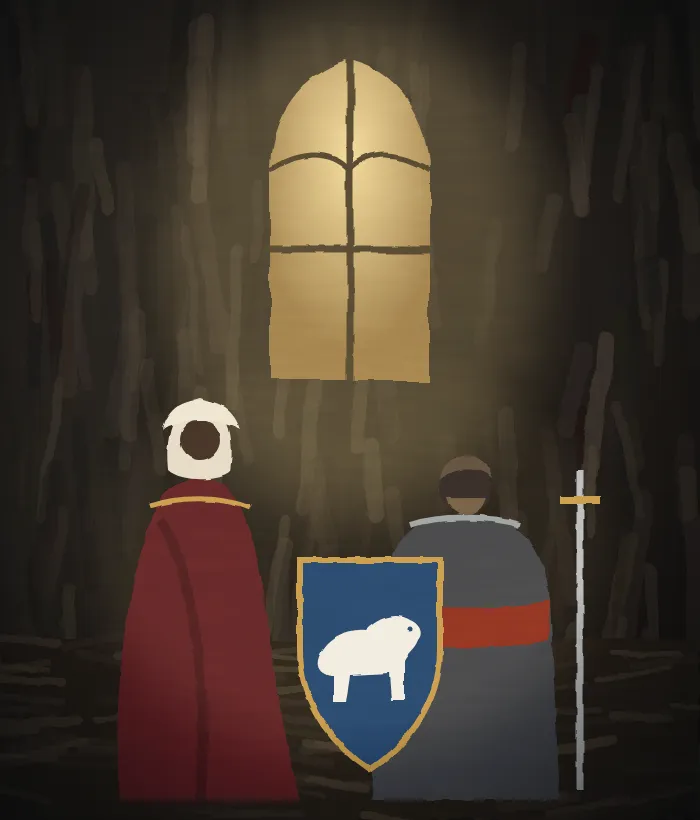
Knightly arms
White polar bear on a blue field
Descendants
Through two of the daughters, along two branches of the family tree
See the line from Olaf Gisli to Akra-Kristín and Sir Torfi

15 generations.

  1. 0
  2. 1
  3. 2⚭ Guðrún Birgitta Gísladóttir
  4. 3
  5. 4
  6. 5
  7. 6
  8. 7
  9. 8
  10. 9
  11. 10
  12. 11
  13. 12
  14. 13
  15. 14⚭ Abbot Einar Benediktsson
  16. 15
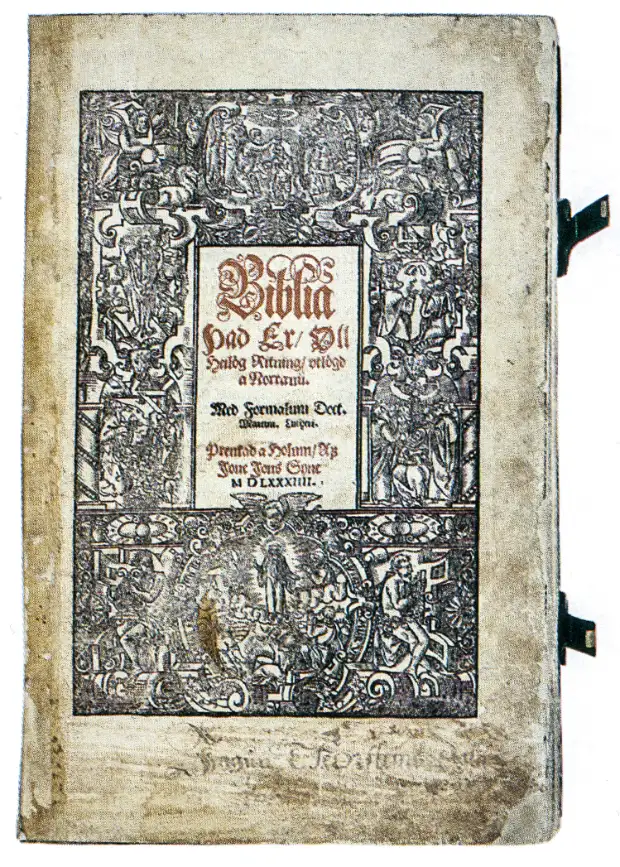
The title page of Guðbrandsbiblía, printed at Hólar in 1584
The title page of Guðbrandsbiblía, printed at Hólar in 1584Public domain
Documentedc. 1455–1520

Jón Sigmundsson

Lawman of North and West Iceland

One of the combative chieftains of the late Middle Ages. He fell into a bitter dispute with the bishop of Hólar, was excommunicated and lost almost everything. His grandson became Iceland's great bishop, Guðbrandur Þorláksson.

The connection to the manuscript containing Gísla saga is a possibility that scholars have pointed to, not an established fact.

Read the whole story

Jón was the illegitimate son of the priest Sigmundur Steinþórsson and Solveig Þorleifsdóttir. He became district sheriff in Eyjafjörður in 1481 and in Húnavatnssýsla in 1493 and lived mostly at Víðidalstunga. In 1508 he sailed to Norway and received the king's appointment as lawman for the north and west.

Bishop Gottskálk Nikulásson of Hólar held that Jón and his second wife, Björg Þorvaldsdóttir, were too closely related to be married, and accused him of cheating on the tithe. The bishop excommunicated him and had heavy fines imposed on him. Jón lost most of his fortune to the Church and lived out his last years in poverty at Krossanes. The bishop and he died within a few months of each other in 1520.

His daughter Helga became the mother of Bishop Guðbrandur Þorláksson, who printed the first Icelandic Bible at Hólar in 1584 and fought for decades to recover his grandfather's estates. Helga's son by her first marriage, Jón Kráksson, is the next link in our line. Jón Sigmundsson may also have been the first owner of the manuscript that contains Gísla saga Súrssonar, the saga of the outlaw Gísli.

Víðidalstunga, the farm of Þorleifur Árnason and Jón Sigmundsson
Lawman
1509–1518
Daughter in the family tree
Helga Jónsdóttir
See the line from Olaf Gisli to Jón Sigmundsson

14 generations.

  1. 0
  2. 1
  3. 2⚭ Guðrún Birgitta Gísladóttir
  4. 3⚭ Ólafur Pálsson
  5. 4inherited Viðey
  6. 5
  7. 6
  8. 7from Espihóll
  9. 8the bishop's daughter
  10. 9
  11. 10schoolmaster and district sheriff
  12. 11⚭ Gísli Hákonarson
  13. 12dean at Garðar
  14. 13mother of Bishop Guðbrandur
  15. 14
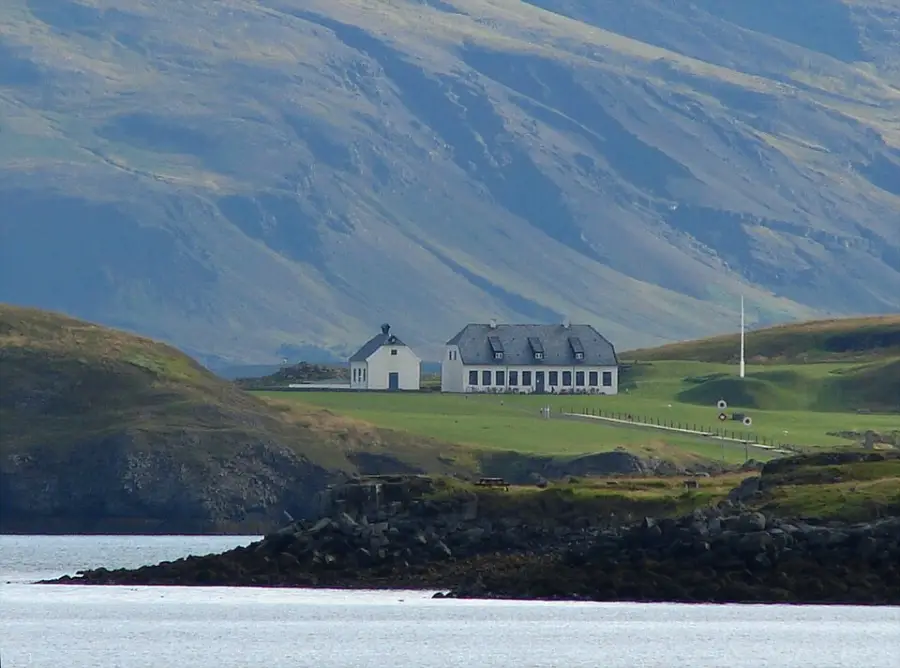
Viðeyjarstofa, designed by Nicolai Eigtved and built 1753–55
Iceland · 1500–1907

Priests, poets and officials

For seven hundred years Hólar was the capital of North Iceland, with a bishop's see, a Latin school and a printing press.
Viðeyjarstofa, designed by Nicolai Eigtved and built 1753–55

In the more recent centuries the family can be followed in parish registers and official archives: the abbots of Munkaþverá, the hymn writer Einar í Eydölum, Lawman Gísli Hákonarson, Bauka-Jón at Hólar, Högni the father of priests, and the Stephensen family, who governed Iceland from Viðey.

Munkaþverá in Eyjafjörður, where the monastery stood
Munkaþverá in Eyjafjörður, where the monastery stoodCC BY-SA 3.0
Documented† 1532

Finnbogi Einarsson

and his father, Abbot Einar Benediktsson
Abbot of Munkaþverá monastery

Father and son were abbots of the monastery at Munkaþverá in Eyjafjörður and ran a school there, attended by the future bishop Jón Arason.

Read the whole story

Einar Benediktsson (died 1524) was a priest at Hólar in 1466, later at Grenjaðarstaður and for twenty years at Skinnastaður. In 1496 he became abbot of Munkaþverá, a Benedictine monastery founded in 1155. Einar kept a school in the monastery.

One of the pupils was Jón Arason, Iceland's last Catholic bishop. Einar's companion was Guðrún Torfadóttir, daughter of the royal governor Torfi Arason and Akra-Kristín, one of the richest couples in the land. Their son Finnbogi was a priest at Hólar and Grenjaðarstaður, assisted his father from 1517 and himself became abbot when his father died.

He was said to be very learned and a good Latinist. With Ingveldur Sigurðardóttir Finnbogi had three children. His daughter Guðrún became the mother of the hymn writer Einar Sigurðsson í Eydölum.

Monastery
Munkaþverá, Benedictines
Daughter in the family tree
Guðrún Finnbogadóttir
See the line from Olaf Gisli to Finnbogi Einarsson

13 generations.

  1. 0
  2. 1
  3. 2⚭ Guðrún Birgitta Gísladóttir
  4. 3
  5. 4
  6. 5
  7. 6
  8. 7
  9. 8
  10. 9
  11. 10
  12. 11
  13. 12
  14. 13
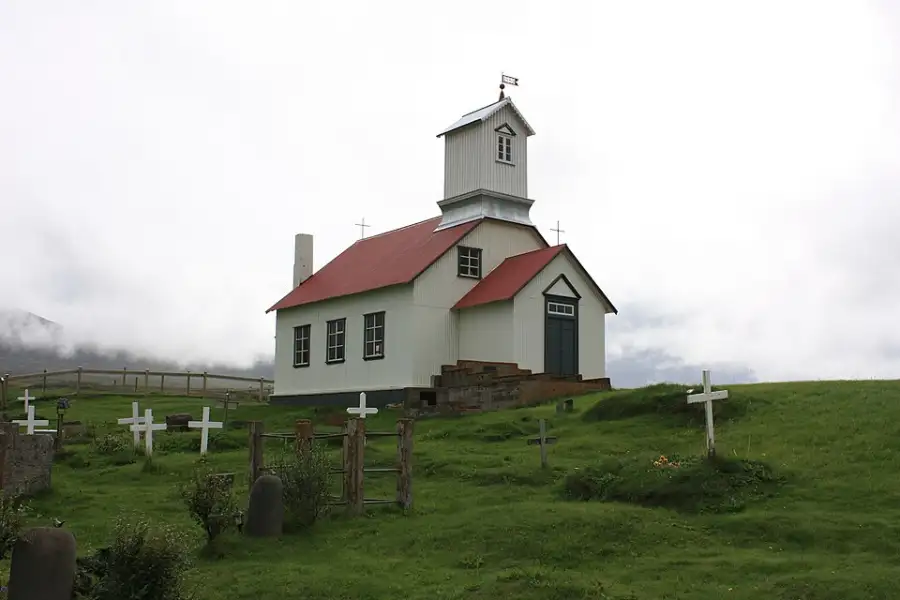
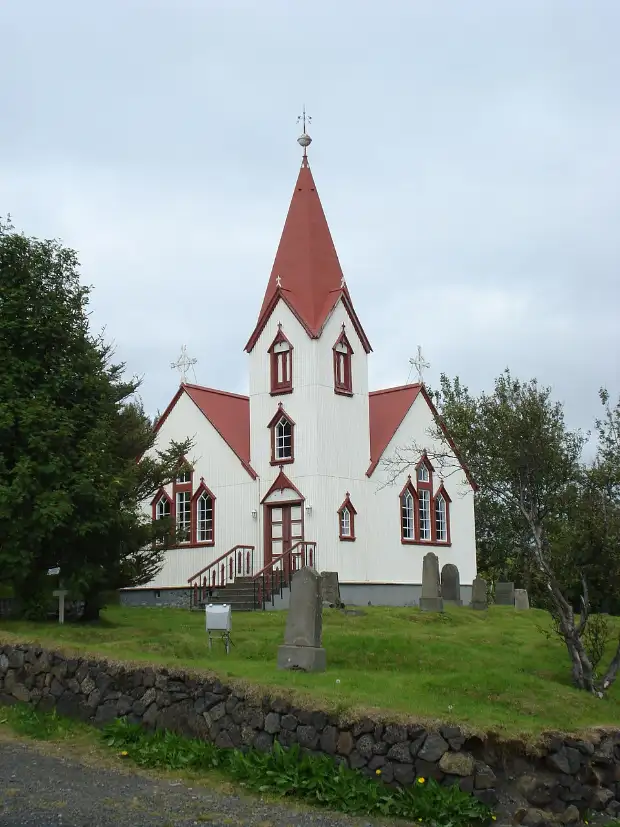
The church at Heydalir (Eydalir) in Breiðdalur, where Einar was pastor
The church at Heydalir (Eydalir) in Breiðdalur, where Einar was pastorCC BY-SA 2.0 de
Documented1539–1626

Einar Sigurðsson í Eydölum

Pastor and the leading religious poet of his day

He wrote the Christmas poem “Nóttin var sú ágæt ein”, which Icelanders still sing to Sigvaldi Kaldalóns' melody. His son Oddur became bishop of Skálholt.

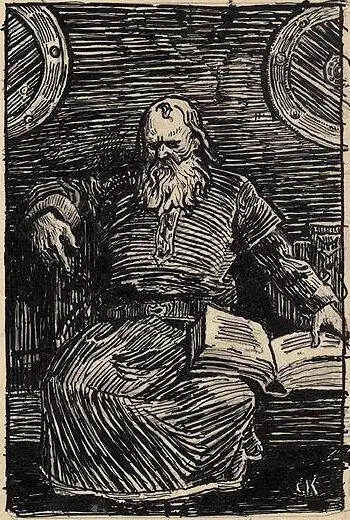
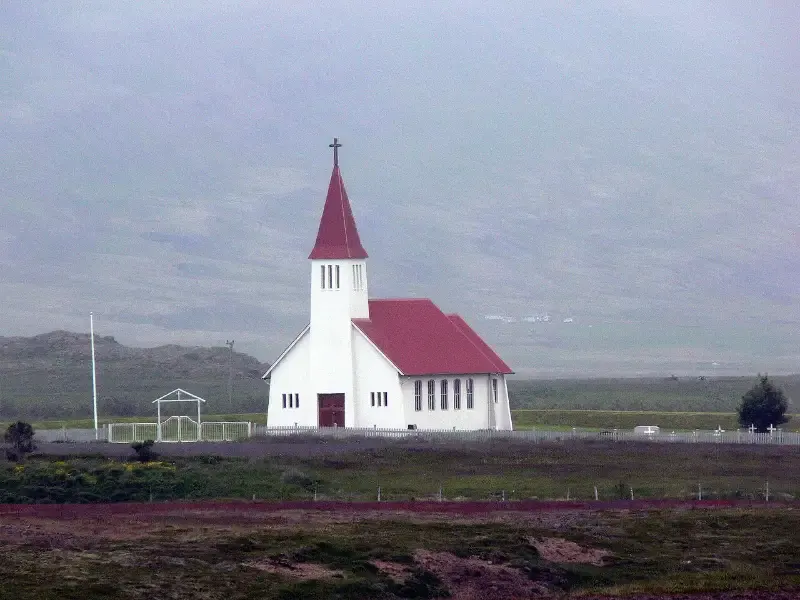
Read the whole story

Einar was the son of Sigurður Þorsteinsson and Guðrún Finnbogadóttir, daughter of the abbot of Munkaþverá. He went to school at Hólar and was for a long time pastor at Nes in Aðaldalur, where he lived in straitened circumstances. He lost his first wife when the children were small, remarried and had many children.

When his son Oddur became bishop of Skálholt, he gave his father the good living of Heydalir in Breiðdalur, and there Einar prospered. He was a friend of Bishop Guðbrandur Þorláksson at Hólar, and the first part of Guðbrandur's great hymnal, the Vísnabók of 1612, was mostly written by Einar. He wrote chiefly religious poems in the vikivaki metre, the form of the old dance ballads.

The best known is “Kvæði af stallinum Kristí”, the poem of Christ's manger, which begins “Nóttin var sú ágæt ein”. Today it is sung as a Christmas carol to Sigvaldi Kaldalóns' melody. His son Sigurður is the next link in our line.

Recordings of the song can be found today on Spotify and YouTube, among others by the Reykjavík Cathedral Choir, múm and the Iceland Symphony Orchestra.

Mother
Guðrún Finnbogadóttir
Son in the family tree
Sigurður Einarsson
See the line from Olaf Gisli to Einar Sigurðsson í Eydölum

11 generations.

  1. 0
  2. 1
  3. 2⚭ Guðrún Birgitta Gísladóttir
  4. 3
  5. 4
  6. 5
  7. 6
  8. 7
  9. 8
  10. 9
  11. 10
  12. 11
Lawman Gísli Hákonarson at the Law Rock at Þingvellir with his gilded law book
Lawman Gísli Hákonarson at the Law Rock at Þingvellir with his gilded law bookAI illustration
Documented1583–1631

Gísli Hákonarson

Lawman at Bræðratunga

The lawman who was never drunk at the Althing. His gilded law book survives to this day.

Read the whole story

Gísli was born in 1583, the son of District Sheriff Hákon Árnason and Þorbjörg Vigfúsdóttir. He attended the Skálholt school and in 1613 was elected lawman for the south and east. From 1617 he lived at Bræðratunga.

He is described as “one of the tallest of men in stature, the most courteous and splendid in bearing, mild and cheerful, loyal as a troll to his friends”, and the sources stress that he was never drunk at the Althing. He got on well with the Danish officials but held fast to Icelandic law. His law book, richly gilded, survives to this day.

He fell ill at the funeral of the neighbouring bishop Oddur Einarsson and died shortly afterwards, on 10 February 1631.

Office
Lawman for the south and east from 1613
Son in the family tree
Vigfús Gíslason, father of Bishop Jón Vigfússon
See the line from Olaf Gisli to Gísli Hákonarson

11 generations.

  1. 0
  2. 1
  3. 2⚭ Guðrún Birgitta Gísladóttir
  4. 3⚭ Ólafur Pálsson
  5. 4inherited Viðey
  6. 5
  7. 6
  8. 7from Espihóll
  9. 8the bishop's daughter
  10. 9
  11. 10schoolmaster and district sheriff
  12. 11
The cathedral at Hólar in Hjaltadalur
The cathedral at Hólar in HjaltadalurPublic domain
Documented1643–1690 · bishop 1684–1690

Jón Vigfússon

“yngri” · Bauka-Jón
Bishop of Hólar

District sheriff, convicted of illegal trading and a bishop nonetheless. He was called Bauka-Jón after the tobacco boxes he sold, and his daughters became models for characters in Halldór Laxness' novel Iceland's Bell.

Read the whole story

Jón was born on 15 September 1643 at Stórólfshvoll in South Iceland. His father, Vigfús Gíslason, had studied in Copenhagen and the Netherlands and at twenty had become schoolmaster at Hólar, known for setting such high demands that the pupils went home. His mother, Katrín Erlendsdóttir, was called “the rich”.

Jón studied in Copenhagen and became district sheriff in Borgarfjörður. In 1672 he was removed from office for illegal trading. He travelled to Copenhagen to seek redress and came home with a promise of the bishopric and a master's title from Chancellor Peder Griffenfeld. There were rumours of bribery, and he was not even a trained priest.

He was consecrated bishop in 1684 and led the diocese of North Iceland until his death in 1690. Hólar had been North Iceland's ecclesiastical and cultural centre since 1106, with a Latin school and a printing press. He was called Bauka-Jón after the tobacco boxes, baukar, that he sold at his farm Leirá, and his trading cost him dearly. The complaints against him followed him to his death, and only his son Þórður had the verdict overturned in the Supreme Court in Copenhagen in 1693.

He was married to Guðríður Þórðardóttir, and a large family has come from their children. Their daughter Þórdís was the model for Snæfríður Íslandssól in Halldór Laxness' novel Iceland's Bell, and their daughter Sigríður yngri and her husband, Bishop Jón Vídalín, for the bishop and his wife at Skálholt. The eldest daughter, Sigríður eldri (1669–1725), married Magnús Björnsson at Espihóll in Eyjafjörður. She is the next link in our line and great-grandmother of Governor Ólafur Stefánsson.

Father
Vigfús Gíslason, district sheriff
Daughter in the family tree
Sigríður eldri, married at Espihóll
Diocese
Hólar, North Iceland
See the line from Olaf Gisli to Jón Vigfússon

9 generations.

  1. 0
  2. 1
  3. 2⚭ Guðrún Birgitta Gísladóttir
  4. 3⚭ Ólafur Pálsson
  5. 4inherited Viðey
  6. 5
  7. 6
  8. 7from Espihóll
  9. 8the bishop's daughter
  10. 9
The church at Breiðabólstaður in Fljótshlíð
The church at Breiðabólstaður in FljótshlíðPublic domain
Documented1693–1770

Högni Sigurðsson

Presta-Högni
Pastor and dean, father of eight priests

He had seventeen children, and all eight sons became priests. At Midsummer 1760 they all stood in full vestments in the church at Breiðabólstaður, with their father himself as the ninth.

Read the whole story

Högni was born on 11 August 1693, the son of the pastor Sigurður Högnason, and grew up at Einholt on Mýrar in Hornafjörður. He attended the Skálholt school, was ordained in 1714 and was pastor at Kálfafellsstaður, later at Stafafell in Lón and from 1750 at Breiðabólstaður in Fljótshlíð. For many years he was dean of the Skaftafell districts.

He was a skilled linguist and translated a textbook for children that was used for generations. He also kept one of the oldest surviving parish registers in Iceland. With his wife Guðríður Pálsdóttir he had seventeen children, and all eight sons became priests. According to tradition they all appeared in vestments at Breiðabólstaður at Midsummer 1760, and that is why he is called Presta-Högni.

His son Böðvar (1727–1779) is the next link in our line. Böðvar's son Þorvaldur also became a pastor and dean.

Wife
Guðríður Pálsdóttir (1694–1762)
Son in the family tree
Böðvar Högnason, pastor
See the line from Olaf Gisli to Högni Sigurðsson

7 generations.

  1. 0
  2. 1
  3. 2⚭ Guðrún Birgitta Gísladóttir
  4. 3
  5. 4
  6. 5
  7. 6
  8. 7
Viðeyjarstofa, designed by Nicolai Eigtved and built 1753–55
Viðeyjarstofa, designed by Nicolai Eigtved and built 1753–55Public domain
Documented1731–1812

Ólafur Stefánsson

Stephensen
Iceland's first Icelandic-born governor

The pastor's son from Skagaströnd who in 1790 became the first Icelander in Iceland's highest office. He is the forefather of the powerful Stephensen family.

Read the whole story

Ólafur was born on 3 May 1731 at Höskuldsstaðir on Skagaströnd, the son of the pastor Stefán Ólafsson and Ragnheiður Magnúsdóttir. He went to school at Hólar and took his law degree in Copenhagen in 1754.

He married Sigríður, daughter of District Governor Magnús Gíslason, the most powerful official in the country. At the wedding the bride was led to the altar by bishops. Ólafur worked his way up through the offices and in 1790 was appointed governor of Iceland, the first Icelander ever to hold the post.

He held the office until 1806. His sons took the name Stephensen, and the family came to shape Iceland's official class for generations. The family later acquired the island of Viðey off Reykjavík, where Viðeyjarstofa stands. The house is Iceland's oldest stone house and was designed by the Danish architect Nicolai Eigtved, who also designed Amalienborg.

Office
Governor 1790–1806
Son
Magnús Stephensen
See the line from Olaf Gisli to Ólafur Stefánsson

6 generations.

  1. 0
  2. 1
  3. 2⚭ Guðrún Birgitta Gísladóttir
  4. 3⚭ Ólafur Pálsson
  5. 4inherited Viðey
  6. 5
  7. 6
Magnús Stephensen, portrait in Viðeyjarstofa
Magnús Stephensen, portrait in ViðeyjarstofaPublic domain
Documented1762–1833

Magnús Stephensen

Chief justice, man of the Enlightenment and printer

Iceland's first chief justice and the great voice of the Enlightenment. For more than 30 years he decided almost single-handedly which books were printed in Iceland.

Read the whole story

Magnús was born on 27 December 1762 at Leirá and was given the island of Brokey as a naming gift by his grandfather. He took his law degree in Copenhagen in 1788.

As a young student he was sent to Iceland to investigate the eruption of Laki, the Skaftáreldar, in 1783. The ship drifted to Norway, and when he finally arrived he found a country in famine. The eruption and the years that followed cost about a fifth of the population their lives.

In 1794 he founded a society for popular enlightenment, and in 1800 he became the first chief justice of Iceland's new High Court. He published periodicals, textbooks and hymnals and owned the country's only printing press. During the Napoleonic Wars he wrote to Sir Joseph Banks in London, warning that Iceland would starve if the ships did not come.

After his death in 1833 his son Ólafur Magnússon Stephensen inherited the island of Viðey and lived there until his death in 1872.

Office
Chief justice of the High Court from 1800
Son in the family tree
Ólafur M. Stephensen (1791–1872)
See the line from Olaf Gisli to Magnús Stephensen

5 generations.

  1. 0
  2. 1
  3. 2⚭ Guðrún Birgitta Gísladóttir
  4. 3⚭ Ólafur Pálsson
  5. 4inherited Viðey
  6. 5
Cathedral Dean Ólafur Pálsson in clerical ruff in front of Reykjavík Cathedral
Cathedral Dean Ólafur Pálsson in clerical ruff in front of Reykjavík CathedralAI illustration
Documented1814–1876

Ólafur Pálsson

Cathedral dean and priest at Reykjavík Cathedral

Priest and dean for four decades, for seventeen years priest at Reykjavík Cathedral. His son Ólafur became Olaf Gisli's paternal grandfather.

Read the whole story

Ólafur was born on 7 August 1814 at Ásar in Vestur-Skaftafellssýsla. His mother was Kristín Þorvaldsdóttir, daughter of the pastor Þorvaldur Böðvarsson. He became pastor at Reynivellir in Kjós in 1843, later at Stafholt and from 1854 to 1871 at Reykjavík Cathedral.

He ended his career as pastor at Melstaður in Miðfjörður, where he died in 1876. Along the way he was dean of three deaneries. In 1843 he married Guðrún Ólafsdóttir Stephensen (1820–1899) of the powerful Stephensen family.

Their son Ólafur Ólafsson (1851–1907) also became a pastor and dean, and he was the father of Gísli Ólafsson, Olaf Gisli's father.

Wife
Guðrún Ólafsdóttir Stephensen
Son in the family tree
Ólafur Ólafsson (1851–1907), dean
See the line from Olaf Gisli to Ólafur Pálsson

3 generations.

  1. 0
  2. 1
  3. 2⚭ Guðrún Birgitta Gísladóttir
  4. 3
Denmark · 1917 –

Gisli of Denmark

Mate Gisli Olafsson, Iceland.Zealand diocesan authority, 1921, on Olaf's father
The Gisli Clan in the Blue Lagoon · © The Gisli Clan

Gisli of Denmark is the Danish family with Icelandic roots. It began when the young Icelandic ship's mate Gísli Ólafsson came to Copenhagen during the First World War and had a son with Ida Alhvilda Andersen. The boy, Olaf, was born in Copenhagen in 1917.

By Icelandic custom he would have been called Olaf Gíslason, son of Gísli. But the Danish naming rules did not fit the Icelandic ones, so he took his mother's surname and was christened Olaf Gisli Andersen, with his father's first name as a middle name. In 1970 he had Andersen removed. That is how an Icelandic first name became a Danish family name, and Olaf became the first Gisli of Denmark.

Every descendant born a Gisli has their own number in the line after him, written in runes and Roman numerals, as a sign of both Nordic and Roman blood. We write stories only about those who are no longer with us.

Ship's mate Gísli Ólafsson on the quayside in Copenhagen during the First World War
Ship's mate Gísli Ólafsson on the quayside in Copenhagen during the First World WarAI illustration
Documented1896–1974

Gísli Ólafsson

Ship's mate, Olaf's father

The Icelandic mate who came to Copenhagen during the First World War and had a son, Olaf, with Ida Alhvilda Andersen. His first name became the Danish family name Gisli.

Read the whole story

Gísli was born on 19 September 1896 in the parish of Staðarhóll in Dalasýsla, where his father was the pastor. He was the eldest son of Dean Ólafur Ólafsson and Guðrún Birgitta Gísladóttir. As a small boy he was already placed in the care of his maternal grandfather, the wealthy farmer Gísli Oddsson, after whom he was named, and in the 1901 census the five-year-old Gísli is living with him at Lækjarós in Dýrafjörður.

As a young man he went to sea and became a mate. During the First World War he came to Copenhagen, where his maternal uncle, the barrister Oddur Gíslason, lived in Gentofte. There he met Ida Alhvilda Andersen, and on 23 March 1917 she gave birth to their son Olaf at Rigshospitalet. Gísli was 20, Ida 18.

They did not marry, and Olaf grew up with his grandparents in Værløse. In 1921 the Zealand diocesan authority ordered “Mate Gisli Olafsson, Iceland” to pay maintenance for the boy, and the decision was served on his uncle in Gentofte.

By Icelandic custom the boy would have been called Olaf Gíslason. But under Danish naming rules he took his mother's surname and was christened Olaf Gisli Andersen, with his father's first name as a middle name. That is how Gísli Ólafsson's first name became the Danish family name Gisli.

Gísli died on 5 April 1974 in Copenhagen.

Born
19 September 1896, parish of Staðarhóll
Parents
Dean Ólafur Ólafsson and Guðrún Birgitta Gísladóttir
Died
5 April 1974 in Copenhagen
See the line from Olaf Gisli to Gísli Ólafsson

1 generations.

  1. 0
  2. 1
Olaf Gisli in the carpentry workshop
Olaf Gisli in the carpentry workshop© The Gisli Clan
Documented1917–1990

Olaf Gisli

Olaf Gisli Andersen · Gisli I
Master builder and resistance fighter

The first Gisli of Denmark. Born in Copenhagen, the son of the Icelander Gísli Ólafsson and Ida Alhvilda Andersen. A carpenter in Hareskov and leader of a resistance group in the last winter of the Occupation. He was taken by the Gestapo in March 1945 and held in Frøslev Camp until the Liberation.

Takes over the leadership of the group after W. Collin's arrest.The Museum of Danish Resistance database entry on Olaf Gisli Andersen
Read the whole story

Olaf was born on 23 March 1917 at Rigshospitalet in Copenhagen and christened Olaf Gisli Andersen on 5 April. His mother was the unmarried Ida Alhvilda Andersen, aged 18. His father was the Icelandic mate Gísli Ólafsson, and in 1921 the Zealand diocesan authority ordered Gísli to pay maintenance for the boy.

Olaf grew up with his grandparents in Værløse and was confirmed in Værløse Church in 1931. He became a carpenter and on 3 July 1937 was married in a civil ceremony to Inga Marcussen in Hareskov. In the late summer of 1944 the fishmonger Wilfred Collin gathered four young men from Hareskov on the town's football pitch and asked whether they would join the resistance.

All four said yes, Olaf among them. When Collin was taken by the Gestapo around Christmas, Olaf took over the leadership of the group. The group went underground, trained with weapons and hid them in places such as the gasworks in Hareskovby.

One Sunday in March 1945 Olaf was recognised by an informer in Hareskov. He was arrested on 4 March as “leader of an illegal resistance group” and sent to Frøslev Camp on 29 March, where he lived in barrack H 12, room 7, until the Liberation in May. The group carried on and became the 6th Company of the Kulsvier Battalion.

Olaf later became a master builder and moved to Køge in 1961. In 1970 he had the name Andersen removed, so that the family bore the name Gisli alone. He died on 26 July 1990 in Køge and lies in Kloster Cemetery.

With him and Inga the Danish branch of the family began.

Olaf Gisli at a party. His wife Inga is sitting on the left of the picture
Frøslev Camp on 5 May 1945, the day of release
The RAF attack on Shellhuset, the Gestapo headquarters, 21 March 1945
Born
23 March 1917 at Rigshospitalet
Mother
Ida Alhvilda Andersen
Father
Gísli Ólafsson, mate
Married
3 July 1937 to Inga Marcussen
Arrested
4 March 1945
Frøslev Camp
29 March – May 1945
Died
26 July 1990 in Køge
The Gisli Clan's coat of arms: the raven from the Vikings' raven banner in a Roman laurel wreath, with the words Gisli of Denmark
The Gisli Clan's coat of arms

The raven in the wreath

The Gisli Clan's coat of arms unites the family's two lines of inheritance in a single emblem. In the centre flies the raven from the Vikings' raven banner. Around it closes the laurel wreath, Rome's sign of victory and honour.

The raven banner
The raven was Odin's bird. His two ravens, Huginn and Muninn, thought and memory, flew out over the world every day and came home with news. The Anglo-Saxon Chronicle relates that in 878 the English captured a raven banner from a brother of Ivar and Halfdan, the sons of Ragnar Lodbrok. A later chronicle says that Ragnar's three daughters had woven it in a single day, and that the raven seemed to beat its wings before a victory and hung still before a defeat.

Later Jarl Sigurd of Orkney, Cnut the Great and Harald Hardrada bore the raven on their banners. In the coat of arms it stands for courage, vigilance and the family's memory, for Muninn means precisely memory.

The laurel wreath

In Rome a victorious general was crowned with laurel when he rode in triumph through the city, and the wreath became the emblem of the emperors. According to myth, the nymph Daphne turned herself into a laurel tree to escape the god Apollo, and he made the tree evergreen in her honour. That is why the laurel also stands for that which does not wither.

In the coat of arms the wreath recalls the family's Roman branch, the Theodosian emperors, and honour, victory and that which endures.

The raven in the wreath: Nordic and Roman blood in a single sign. The same idea lies behind the Gisli numbers in the clan. Everyone born a Gisli is given a number in the line, and the number is written in two ways: the name Gisli in Norse runes (ᚴᛁᛋᛚᛁ) and the place in the line in Roman numerals. Olaf, the first, is ᚴᛁᛋᛚᛁ I. The runes stand for the heritage of the Vikings and Iceland, the Roman numerals for the heritage of Rome.

Questions and answers

Frequently asked questions

Is the Gisli family descended from Ragnar Lothbrok?

The family tree shows two proposed paths to Ragnar Lodbrok, whom many know as Ragnar Lothbrok from the TV series Vikings. One runs through Ragnar's son Sigurd Snake-in-the-Eye, the Oddi family and the kings of Norway, the other through his son Björn Ironside, Snorri Sturluson and Landnámabók. Both contain an uncertain link in the Middle Ages, and the oldest generations follow the genealogical traditions of the sagas. Each person is marked with the kind of source that supports the link.

Who is Gisli of Denmark?

Gisli of Denmark is the Danish family with Icelandic roots. It began with the Icelandic mate Gísli Ólafsson (1896–1974) and his son Olaf Gisli (1917–1990), who was born in Copenhagen. Under Danish naming rules, the father's Icelandic first name became the son's surname, and Olaf became the first Gisli of Denmark.

Which famous people are in the family tree?

The family's ancestors include the Viking king Ragnar Lodbrok (Ragnar Lothbrok) and his sons Björn Ironside and Sigurd Snake-in-the-Eye, King Ælla of Northumbria, the Norwegian kings Harald Fairhair, Harald Hardrada and Magnus Barefoot, the Icelandic scholars Sæmundur fróði and Snorri Sturluson, the Jerusalem pilgrim Björn Jórsalafari and the bridal couple from Hvalsey Church in Greenland. According to the English genealogies, the line continues to the Roman emperors Theodosius I and Valentinian III.

How is the family tree documented?

The most recent generations are documented in parish registers, censuses and Danish and Icelandic archives. The medieval links are known from letters and deeds in Diplomatarium Islandicum, from the Icelandic annals and from Sturlunga saga. The Viking Age is known from Landnámabók, Heimskringla and Flateyjarbók, and the link to Rome follows the English genealogies. Every person on the site is marked with their source grade.

Can you be related to the Vikings?

Almost everyone with Nordic roots is descended from people who lived in the Viking Age. What makes Icelandic families special is that they were written down as early as the 12th and 13th centuries in Landnámabók and the sagas, so you can follow the line name by name instead of just guessing.

About the sources

How do we know them?

Christian Krohg's painting of the saga writer Snorri Sturluson
Christian Krohg, Snorri Sturluson
Illuminated initial from Flateyjarbók with two kings
Flateyjarbók, 1387–94

The most recent generations we know from parish registers, the Danish National Archives, the Icelandic censuses at manntal.is and the Museum of Danish Resistance database. Medieval Iceland we know from letters and deeds in Diplomatarium Islandicum, from the annals and from Sturlunga saga. Further back the sources become manuscripts: Landnámabók, Heimskringla and great compilations such as Flateyjarbók, in which the royal lineages were traced all the way back to Odin.

The emperors of the Roman Empire we know from contemporary historians, laws and coins. The connection between Rome and the North runs through the Vandal king Hilderic's daughter Hildis, and we follow it as Roderick Stuart presents it in the English genealogy books. The legendary kings of Lejre live on in Beowulf, in Saxo and in the Icelandic sagas.

The family tree is built up from the sources, link by link. It shows documented ancestors as well as proposed and traditional family connections. Uncertain links, saga tradition and mythological royal lines are marked separately.

Documented

Parish registers, archives and contemporary records.

Historical

Known from contemporary sources: chronicles, coins, laws.

Saga

Known from sagas, Landnámabók and medieval genealogical registers.

Genealogy books

Links given by the English genealogy books but mentioned in no older source.

Myth

Gods and legendary figures to whom the royal houses traced their lineage.

Images
  • Hans Dahl, Leif the Lucky Discovers America (c. 1900) · Public domain · Wikimedia Commons
  • Georg von Rosen, Odin as a Wanderer (1886) · Public domain · Wikimedia Commons
  • The Ledberg Stone, Östergötland. The image is interpreted as Odin being swallowed by the wolf Fenrir · Public domain · Wikimedia Commons
  • Luplau Janssen, King Skjold Comes to Denmark (1912) · Public domain · Wikimedia Commons
  • Bror Hillgren, Ivar Vidfamne (1915) · Public domain · Wikimedia Commons
  • August Malmström, The Battle of Brávellir · Public domain · Wikimedia Commons
  • Hugo Hamilton, King Harald Wartooth Falls in the Battle of Brávellir · Public domain · Wikimedia Commons
  • Theodosius I on the silver dish from Mérida, the Missorium of Theodosius (388) · Public domain · Wikimedia Commons
  • Gold solidus, Arcadius, 403 · CC0 · American Numismatic Society · Wikimedia Commons
  • Gold solidus, Theodosius II (408–450) · CC0 · Metropolitan Museum of Art · Wikimedia Commons
  • Gold solidus, Galla Placidia, 422 · CC BY 3.0 · Sailko · Wikimedia Commons
  • The starry sky in the Mausoleum of Galla Placidia, Ravenna · CC BY-SA 4.0 · Petar Milošević · Wikimedia Commons
  • Gold solidus, Valentinian III, 426–430 · CC0 · American Numismatic Society · Wikimedia Commons
  • Gold solidus, Licinia Eudoxia · CC BY-SA 2.5 · Classical Numismatic Group · Wikimedia Commons
  • Karl Bryullov, The Sack of Rome by Geiseric in 455 (1833–36) · Public domain · Wikimedia Commons
  • Vandal silver coin struck in Hilderic's name · Public domain · Wikimedia Commons
  • August Malmström, Ragnar and Kraka (c. 1880) · Public domain · Wikimedia Commons
  • Hugo Hamilton, The Death of Ragnar Lodbrok in the Snake Pit · Public domain · Wikimedia Commons
  • Björn Järnsidas hög, the burial mound on Munsö in Lake Mälaren · Public domain · Jacob Truedson Demitz · Wikimedia Commons
  • King Sigurd Snake-Eye, from an older Danish series of kings · Public domain · Wikimedia Commons
  • William Bell Scott, The Danes Land in Northumbria (Wallington Hall) · Public domain · Wikimedia Commons
  • W. G. Collingwood, The Althing at Þingvellir (c. 1897) · Public domain · Wikimedia Commons
  • The cathedral at Hólar in Hjaltadalur · Public domain · Wikimedia Commons
  • Viðeyjarstofa, designed by Nicolai Eigtved and built 1753–55 · Public domain · Wikimedia Commons
  • Magnús Stephensen, portrait in Viðeyjarstofa · Public domain · Wikimedia Commons
  • Christian Krohg, Snorri Sturluson · Public domain · Wikimedia Commons
  • Flateyjarbók (1387–94), initial with Harald Fairhair and Halfdan the Black. The manuscript was in the family's possession until 1647 · Public domain · Wikimedia Commons
  • Olaf Gisli in the carpentry workshop · © The Gisli Clan
  • Olaf Gisli at a party. His wife Inga is sitting on the left of the picture · © The Gisli Clan
  • The title page of Guðbrandsbiblía, printed at Hólar in 1584 · Public domain · Wikimedia Commons
  • Munkaþverá in Eyjafjörður, where the monastery stood · CC BY-SA 3.0 · Pietro · Wikimedia Commons
  • The church at Breiðabólstaður in Fljótshlíð · Public domain · Wikimedia Commons
  • Víðidalstunga, the farm of Þorleifur Árnason and Jón Sigmundsson · CC BY 2.0 · Arian Zwegers · Wikimedia Commons
  • Frøslev Camp on 5 May 1945, the day of release · CC BY-SA 2.0 · Nationalmuseet · Wikimedia Commons
  • The RAF attack on Shellhuset, the Gestapo headquarters, 21 March 1945 · Public domain · Wikimedia Commons
  • Travis Fimmel as Ragnar Lothbrok in Vikings
  • Alexander Ludwig as Björn Ironside in Vikings
  • David Lindström as Sigurd in Vikings
  • Alyssa Sutherland as Aslaug in Vikings
  • Ivan Kaye as King Aelle in Vikings
  • Peter Franzén as King Harald Finehair in Vikings
  • Leo Suter as Harald Sigurdsson in Vikings: Valhalla
  • J. R. Skelton, Queen Wealhtheow Pours Mead in King Hroðgar's Hall Heorot (1908). Hroðgar is the Beowulf poem's name for Hroar · Public domain · Wikimedia Commons
  • Peter Nicolai Arbo, The Battle of Stamford Bridge 1066, where Harald Hardrada fell (1870) · Public domain · Wikimedia Commons
  • Christian Krohg, “When the sun rose, Magnus and his men went ashore”, Magnus Barefoot's last morning in Ulster (1899) · Public domain · Wikimedia Commons
  • Hrafnseyri in Arnarfjörður, the old Eyri, where Hrafn lived and was killed · Public domain · TommyBee · Wikimedia Commons
  • Hvalsey Church in Greenland, where the wedding took place on 16 September 1408 · CC0 · Wikimedia Commons
  • The church at Heydalir (Eydalir) in Breiðdalur, where Einar was pastor · CC BY-SA 2.0 de · Christian Bickel · Wikimedia Commons
  • Sæmundur fróði rides home from Paris on the Devil in the shape of a seal and strikes it with the Psalter as Iceland comes into view · AI illustration
  • Jón Loftsson at Oddi with the boy Snorri Sturluson, who grew up in his household. Hekla in the background · AI illustration
  • Björn Jórsalafari sails towards the Holy Land as a pilgrim · AI illustration
  • Akra-Kristín and Sir Torfi with the polar bear on his shield · AI illustration
  • Lawman Gísli Hákonarson at the Law Rock at Þingvellir with his gilded law book · AI illustration
  • Cathedral Dean Ólafur Pálsson in clerical ruff in front of Reykjavík Cathedral · AI illustration
  • Ship's mate Gísli Ólafsson on the quayside in Copenhagen during the First World War · AI illustration
  • The Gisli Clan in the Blue Lagoon in Iceland · © The Gisli Clan
  • The Gisli Clan's coat of arms · © The Gisli Clan
ᚴᛁᛋᛚᛁ · ᚴᛚᛅᚾ

The clan

The Gisli Clan are Olaf Gisli's descendants. Everyone born a Gisli has a number in the line: Gisli written in Nordic runes and the number in Roman numerals, as a sign that both Nordic and Roman blood runs in the family.

I Gisli IOlaf Gisli

Master carpenter and resistance fighter. The first Gisli of Denmark.

Read the story →
II Gisli IIPreben Gisli

Preben's story is on its way.

III Gisli IIIJanna Gisli

Janna's story is on its way.

IV Gisli IVMajken Gisli
V Gisli VMaibritt Gisli
VI Gisli VIJan Gisli
VII Gisli VIILinette Gisli
VIII Gisli VIIIJesper Gisli
IX Gisli IXNils Gísli
X Gisli XDaniell Gisli Kühl
XI Gisli XIMalthe Gisli-Bødker
XII Gisli XIIAlbert Gísli
XIII Gisli XIIIAnton Vestergaard Gisli
XIV Gisli XIVEmilia Winther Gisli

Inga Gisli, Olaf's wife, bore the family name but was not born a Gisli and therefore has no number in the line.